
Protanopia (Red-Blind): When Red Fades to Black
Protanopia is a red-green color blindness caused by missing red-sensitive L-cones. It does more than confuse red with green — it makes red itself appear very dark, with real consequences for driving and safety.
~1%
Prevalence (Men)
~0.01%
Prevalence (Women)
L
Missing Cone (Red)
Protanopia is a red-green color vision deficiency in which the red-sensitive L-cones are completely absent from the retina. A normal eye has three cone types (L red, M green, S blue); a protanope has only two (M and S), so their color world collapses from three dimensions to two. It shares the "dichromacy" category with deuteranopia (green-blind), but with one crucial difference we cover below.
Colors commonly confused
Black ↔ many shades of red, dark brown ↔ dark green/orange/red, some blues ↔ reds/purples/dark pinks, mid-green ↔ orange. Protanopes often see red as a very dark brown or black.
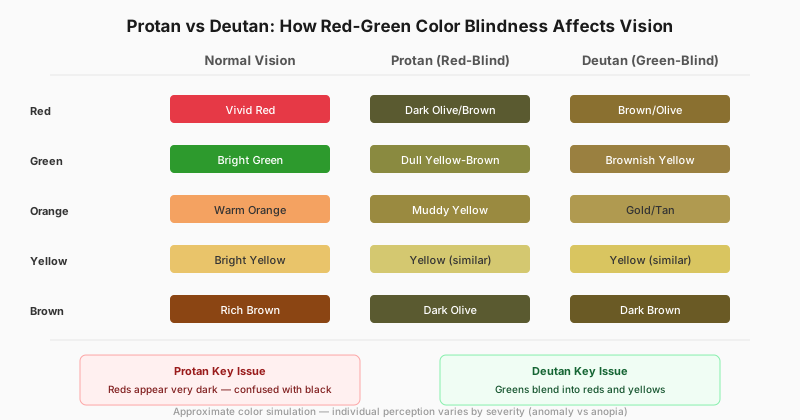
Protanopia vs. deuteranopia: both lose red-green discrimination, but protanopes also see reds dramatically darkened.
What Protanopia Actually Is
Human color vision relies on three cone types. The L-cone peaks in sensitivity around 564 nm (long-wavelength, red light). When the OPN1LW gene that encodes the L-cone photopigment is missing or severely altered, that cone is not produced and red wavelengths generate almost no visual signal. The whole red-orange-yellow-green spectrum collapses into shades of brownish-yellow, and red cannot be told apart from green.
Why Red Looks "Dark" to Protanopes
This is the single most distinctive thing about protanopia, and what cleanly separates it from deuteranopia. The L-cone is not just responsible for "the hue red" — it is the main brightness detector for long-wavelength light. Without it, red light isn't just "not red" to the brain, it's "barely light at all," so red is registered at very low brightness and looks dark brown or black.
A deuteranope is missing the M-cone, and red is still detected by the L-cone, so reds keep normal brightness for them — only the hue shifts. For a protanope, reds are both wrong-hued and dimmed. Clinically, this "red darkening" (the protan luminosity loss) is exactly how an examiner decides whether someone is protan or deutan.
How It Affects Everyday Vision
A protanope does not see the world in gray — blues and yellows stay vivid. What collapses is the red-green axis: a ripe red strawberry among green leaves looks like one uniform color; red warning text on a dark background "sinks in"; red and green lines on a transit map are hard to separate. Combined with red being darkened, a lot of information that is meant to jump out in red instead becomes the least conspicuous.
Causes and Genetics
Protanopia is almost always inherited. The OPN1LW gene sits on the X chromosome (locus Xq28) and is passed down in an X-linked recessive pattern. Males have only one X chromosome, so a single defective copy causes the condition; females have two X chromosomes and need both copies defective — which is why protanopia is overwhelmingly seen in men. If the mother is a carrier, each son has a 50% chance of being protanopic. For a deeper look at inheritance, see our genetics of color blindness guide.
How Protanopia Is Diagnosed
- Ishihara test — fast screen for red-green deficiency; flags protanopia but cannot tell protan from deutan on its own.
- Red-green color blind test — targeted screen of the red-green axis, good for a quick first self-check.
- Farnsworth D-15 test — an arrangement test that reveals the protan confusion axis and separates protan from deutan.
- FM100 Hue test — the most detailed arrangement test; identifies type and severity.
- Anomaloscope — the clinical gold standard, done at an eye clinic.
Protanopia and Driving Safety
Because red signals look dim to protanopes, driving is the real-world scenario protanopia is most associated with. A protanope sees a red traffic light as a dark, dim dot rather than a bright signal, especially at night. The workaround: read a light's position (red on top, green on bottom) rather than its color, and modern LED signals are brighter and more consistent. In most countries color blindness alone does not disqualify an ordinary driver's licence, but some commercial and occupational licences do have color vision requirements. See our guide to driving with color blindness.
When to See a Doctor
Inherited protanopia is stable, lifelong, and needs no treatment in itself. But if your color vision changes suddenly, affects only one eye, or comes with reduced visual acuity, see an eye-care professional promptly — that pattern can point to a retinal or optic-nerve disease rather than inherited color blindness.
Daily Life Impact (5 Concrete Scenarios)
- Traffic and brake lights — red signals look dim; slower reaction at night.
- Judging food — telling raw from cooked meat, or unripe from ripe fruit.
- Charts and maps — red-green data charts and transit maps are hard to read.
- Device indicators — red/green status LEDs (charging, error) are hard to distinguish.
- Red text on dark — red warning text "sinks" into the background and is least conspicuous.
Tips and Adaptation
- Rely on position, order, and labels instead of color alone for signals.
- A phone color-picker app can name an object's true color on the spot.
- OS-level colorblind filters and high-contrast modes improve on-screen reading.
- Choose colorblind-safe palettes (Wong, Viridis) over red-green contrasts.
- Corrective glasses (e.g. EnChroma) help some people but vary — see how color blind glasses work.
Frequently Asked Questions
Sources
- National Eye Institute (NEI) — Overview of color blindness types and prevalence
- American Academy of Ophthalmology (AAO) — Clinical information on red-green color vision deficiency
- Colour Blind Awareness — Protanopia confused-color list and inheritance
- National Health Service (NHS) — Causes and management of colour vision deficiency
Take the Red-Green Test
Screen your red-green vision in 2 minutes
View Simulation
See the world through protanopia
Related Types
- Deuteranopia (Green-Blind) — red-green blindness with missing M-cones; reds keep normal brightness
- Tritanopia (Blue-Blind) — rare blue-yellow deficiency, often acquired
- All 8 types of color blindness — overview