
How Do Color Blind Glasses Work? The Science, the Brands, and What to Actually Expect
Notch-filter technology, peer-reviewed evidence, EnChroma vs. Pilestone, and an honest look at who they help — and who they don't.
Key takeaway
Color blind glasses use spectral notch-filter lenses that selectively block wavelengths of light where the red and green cone signals overlap. This sharpens the brain's ability to distinguish colors — like turning down overlapping frequencies on a music equalizer. They work for roughly 80% of people with red-green color blindness (anomalous trichromacy) but do not cure color blindness and do not work for people with complete cone absence (dichromacy) or total color blindness. Prices range from $99 to $389.
The viral videos are hard to miss: a father puts on a pair of glasses and, for the first time, sees the true color of his child's eyes. He breaks down crying. The video gets 50 million views.
But behind the emotional reactions lies a genuine engineering question: how can a lens make someone see colors they have never seen before? The answer is more nuanced than the videos suggest. Color blind glasses don't create new cone cells or rewire the brain. What they do — through precise optical filtering — is separate color signals that were previously muddled together, letting the brain extract more information from the light it was already receiving.
This guide covers the actual science, the clinical evidence, the major brands and their differences, and — most importantly — an honest assessment of what you should expect if you try them. Not sure what type of color blindness you have? Start with a free Ishihara color blind test to find out, because the type matters enormously for whether glasses will help.
The Problem: Why Color Blind Eyes Confuse Colors
Normal color vision uses three types of cone cells: L-cones (red, peaking at 564 nm), M-cones (green, peaking at 534 nm), and S-cones (blue, peaking at 420 nm). The brain determines color by comparing the relative signal strength of all three.
In people with the most common forms of color blindness — deuteranomaly (green-weak) and protanomaly (red-weak) — one cone type is shifted in its spectral sensitivity. The M-cone or L-cone has moved closer to the other, creating excessive overlap in the signals they send to the brain. When two cones fire almost identically in response to a color, the brain cannot tell whether it is looking at red, green, or something in between.
This overlap is the key. The cones are still there and still functioning — they are just not different enough from each other. That distinction is what makes optical correction possible. For a detailed breakdown of every type, see our guide on types of color blindness.
How Color Blind Glasses Work: Notch-Filter Technology
Color blind glasses use spectral notch filters — thin layers of rare-earth optical material embedded in the lens — that selectively absorb narrow bands of light. These bands correspond to the wavelengths where the L-cone and M-cone sensitivity curves overlap the most.
By removing those overlapping wavelengths, the lens effectively pushes the remaining red and green signals further apart. The brain now receives two clearly different signals instead of two nearly identical ones, and it interprets that difference as distinct colors.
The music equalizer analogy
Imagine you are listening to a guitar and a violin playing notes that are too close together. The sound becomes muddy — you can't tell which instrument is which. An audio engineer would use an equalizer (EQ) to cut the overlapping frequencies, making each instrument sound clean and distinct again.
Notch-filter lenses do exactly this, but with light instead of sound. They cut the "muddy" wavelengths where the red and green cone responses bleed into each other, leaving cleaner color signals for the brain to process (EnChroma [1]).
Why outdoor light works better
Color blind glasses work best in bright, full-spectrum light — particularly outdoor sunlight. This is because sunlight contains all visible wavelengths in roughly equal intensity, giving the notch filter a complete spectrum to work with. Indoor lighting (especially fluorescent or warm LED) has uneven spectral distribution, which reduces the filter's effectiveness. That's why most brands sell separate outdoor lenses (tinted, like sunglasses) and indoor lenses (lighter tint, higher light transmission) — and why outdoor lenses typically produce the more dramatic "wow" moments.
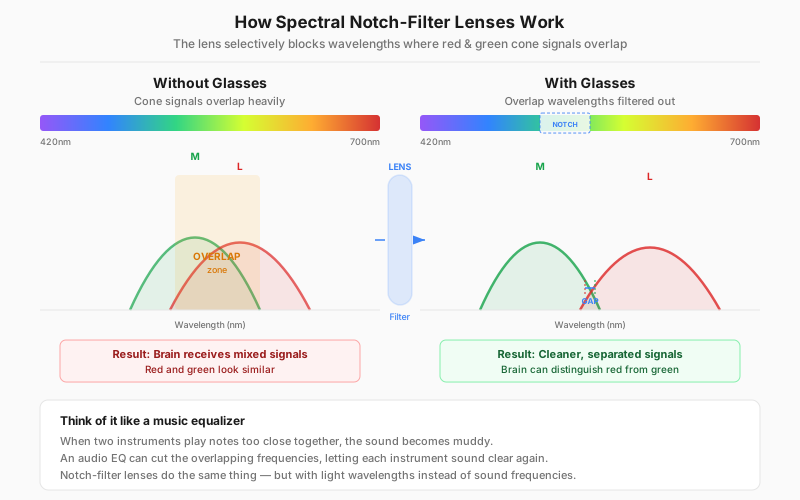
How notch-filter lenses separate the red and green cone signals by blocking the overlapping wavelengths.
Do Color Blind Glasses Really Work? What the Science Says
The 2022 UIW study (published in Nature)
The most significant clinical evidence comes from a study conducted at the University of the Incarnate Word (UIW) Rosenberg School of Optometry, published in Nature's ophthalmology journal Eye in 2022.
- 13 subjects with red-green color blindness wore EnChroma glasses daily for 11–14 days
- Immediate improvement in cone contrast sensitivity and color naming accuracy was observed
- After 12 days, improvements persisted even without wearing the glasses
- VEP (Visual Evoked Potential) testing showed stimulation of the brain's color-processing center — objective, brain-based evidence beyond subjective reports
- At a 6-month follow-up, one subject showed a 3–5x improvement in daytime and outdoor color vision
Citation: Rabin J, Silva F, Trevino N, et al. "Spectral notch filter glasses improve color vision in those with color vision deficiency." Eye. 2022 [2]
Who they work for — and who they don't
This is the critical distinction most articles gloss over. Color blind glasses only work for people who still have all three cone types:
| Type | Cone Status | Prevalence | Glasses Effective? |
|---|---|---|---|
| Deuteranomaly | M-cone shifted | 5% of males | Yes — best results |
| Protanomaly | L-cone shifted | 1% of males | Yes — good results |
| Deuteranopia | M-cone absent | 1.2% of males | No — cone missing |
| Protanopia | L-cone absent | 1% of males | No — cone missing |
| Tritanomaly | S-cone shifted | Very rare | Limited (Pilestone Lens E) |
| Achromatopsia | All cones nonfunctional | 1 in 30,000 | No |
Why this matters
You cannot boost a signal that does not exist. In anomalous trichromacy, the cone is present but shifted — there is a signal, just a noisy one. The glasses clean up that noise. In dichromacy, the cone is physically absent — there is no signal to clean up. This is why knowing your specific type is essential before buying glasses. Our red-green color blind test can help determine severity, but a Farnsworth-Munsell 100 Hue test provides a more precise diagnosis.
Best Color Blind Glasses Compared (2026)
Two brands dominate the market: EnChroma (the premium pioneer) and Pilestone (the value leader). Budget options exist on Amazon, but with significant trade-offs.
EnChroma — Premium Pioneer
Founded in 2010 by a UC Berkeley glass scientist who accidentally discovered the notch-filter effect. EnChroma holds patents on their lens technology, invests in clinical research, and positions as the premium choice.
- Price range: $189–$389
- Lens types: Separate Deutan and Protan lenses, optimized per type
- Indoor + outdoor: Both available
- Prescription: Available on most frames
- Kids: From $189 (ages 5+)
- Return policy: 60-day money-back guarantee
- Warranty: 2 years
- Clinical backing: Yes — UIW/Nature study (2022)
Pilestone — Best Value
A UK-based brand with 15+ years on the market and 40,000+ customers. Pilestone's key advantage is offering five distinct lens types (lettered A through E) that cover the full range of color vision deficiencies — including blue-yellow, which EnChroma does not address.
- Price range: $99–$359
- Lens types: A (mild-moderate red-green), B (strong-severe red-green), C (indoor red-green), D (protan-specific), E (blue-yellow/tritan)
- Indoor + outdoor: Both available
- Prescription: Available ($169+ add-on)
- Kids: From $99
- Return policy: 60-day money-back guarantee
- Warranty: Lifetime (manufacturing defects)
- Unique advantage: Lens E for blue-yellow (tritan) color blindness
Budget Options (Amazon, $20–$60)
Numerous unbranded or Chinese-manufactured color blind glasses sell on Amazon for $20–$60. These typically use simple colored-tint lenses that increase overall color saturation rather than precision spectral notch filters. They may provide a slight improvement for mild cases, but lack the engineered wavelength specificity of EnChroma or Pilestone lenses. No clinical studies back their effectiveness. No return guarantee is standard.
Head-to-Head Brand Comparison
| Feature | EnChroma | Pilestone | Budget (Amazon) |
|---|---|---|---|
| Price range | $189–$389 | $99–$359 | $20–$60 |
| Lens technology | Spectral notch filter | Multi-layer filter | Basic color tint |
| Lens options | Deutan / Protan | A, B, C, D, E | Generic |
| Blue-yellow (tritan) | No | Yes (Lens E) | No |
| Indoor lenses | Yes | Yes | Rarely |
| Prescription | Yes | Yes ($169+) | No |
| Kids frames | $189 (ages 5+) | $99 | Some |
| Clip-ons | Yes | $99 | Yes |
| Return policy | 60 days | 60 days | 30 days (varies) |
| Warranty | 2 years | Lifetime | None |
| Clinical studies | Yes (Nature, 2022) | No | No |
How to Choose the Right Color Blind Glasses
Step 1: Know your type
This is non-negotiable. Different types require different lenses, and some types cannot be helped by glasses at all. Take a free Ishihara test for a quick red-green screening, or the Farnsworth-Munsell 100 Hue test for a complete profile including blue-yellow assessment.
Step 2: Decide indoor vs. outdoor
If you primarily want enhanced color perception outdoors (nature, sports, driving), outdoor lenses will give the best results. If you need help at work (design, wiring, lab work), indoor lenses with higher light transmission are more practical. Some brands offer clip-ons that convert your existing prescription glasses into outdoor color-enhancing lenses.
Step 3: Budget
| Budget | Best option | Notes |
|---|---|---|
| Under $100 | Pilestone clip-ons ($99) | Lowest risk way to try quality lenses |
| $100–$200 | Pilestone full frames ($109–$119) | Best value for a dedicated pair |
| $200–$300 | EnChroma entry ($229) | Clinically validated technology |
| $300+ | EnChroma premium ($299–$389) | Premium frames + prescription |
Step 4: Use the return policy
Both EnChroma and Pilestone offer 60-day money-back guarantees. Because individual results vary significantly (some people see a dramatic difference, others a subtle shift), this return window is essential. Give the glasses at least 2 weeks of daily outdoor use before judging — the UIW study showed that brain adaptation continues over 11–14 days.
What to Realistically Expect
The first 15 minutes
Most users notice an immediate shift: colors appear more saturated, greens look greener, and reds "pop" more than usual. Some people experience an emotional response — particularly if they have never seen certain color distinctions before. Others notice a subtler change. Both are normal. The viral "crying" reaction videos represent one end of the spectrum, not the average experience.
The first 2 weeks
The UIW study showed that sustained daily use produces cumulative neural adaptation. Colors that seemed only slightly different in week one may become distinctly separable by week two. Some users report that after removing the glasses, colors continue to look richer than before — suggesting lasting changes in the brain's color processing pathways.
What they don't do
- They do not cure color blindness. Remove the glasses and your baseline vision returns (though some neural adaptation may persist).
- They do not restore "normal" color vision. They enhance contrast between confused colors, which the brain may interpret as seeing "new" colors, but the perception is not identical to someone with typical trichromacy.
- They may reduce brightness. Because the lens blocks some wavelengths, overall light transmission drops. Outdoor lenses function like tinted sunglasses. This makes them unsuitable for night driving.
- They will not help you pass an occupational color vision test. Most testing protocols require removing any filtered or tinted lenses (WebMD [3]). Concerned about job requirements? See our guide on jobs for colorblind people.
The Future: Beyond Glasses
Gene therapy
Researchers have successfully restored color vision in squirrel monkeys by injecting the gene for the missing cone pigment directly into the retina. Human clinical trials are in early stages. Gene therapy could potentially cure color blindness permanently by growing new, functional cone cells — but this remains years from clinical availability (NEI [4]). For a clear-eyed look at what glasses, gene therapy, and reversible acquired cases can actually do today, see our guide on whether color blindness can be cured.
Contact lens technology
Several companies are developing color-correcting contact lenses using the same notch-filter principles. This would eliminate the cosmetic concern of wearing tinted glasses and provide more consistent performance across lighting conditions. Early prototypes exist but no product has reached mainstream market availability yet.
Digital accessibility
Modern operating systems (iOS, Android, Windows, macOS) now include built-in color filters that perform a similar function to physical glasses — but only for what appears on screen. For children in schools, enabling these filters on tablets and laptops can significantly improve the digital learning experience. Learn more about using these tools in our guide on early signs of color blindness in children.
The Bottom Line
Color blind glasses are a legitimate optical aid backed by peer-reviewed science. They work best for the most common forms of color blindness — deuteranomaly and protanomaly — which together account for about 75% of all color blind people. If you have one of these types, there is roughly an 80% chance that you will see meaningful improvement.
The key steps: First, take a color blind test to confirm your type and severity. Then, choose between EnChroma (premium, clinically validated) or Pilestone (best value, more lens options including tritan). Use the 60-day return window to evaluate whether the glasses make a meaningful difference for your daily life. If they do, the investment pays for itself in richer sunsets, better-matched clothing, and one fewer frustrating question from friends about why you called that green car "brown."
To understand why you are color blind in the first place, read our guide on the genetics of color blindness. For driving-specific concerns, see driving with color blindness.
Sources
- EnChroma. "How EnChroma Glasses Work." enchroma.com
- Rabin J, et al. (2022). "Spectral notch filter glasses improve color vision in those with color vision deficiency." Eye. Nature. nature.com
- WebMD. "What to Know About Colorblind Glasses." webmd.com
- National Eye Institute. "Color Blindness." nei.nih.gov
- Pilestone. "How Pilestone Glasses Work." pilestone.com