
Best Jobs for Colorblind People (and Careers to Avoid) in 2026
"Can I be a pilot if I'm colorblind?" is one of the most common questions we hear. The short answer: it depends on the type and severity.
Color vision deficiency (CVD) affects roughly 8% of males and 0.5% of females according to the National Eye Institute, which means approximately 300 million people worldwide navigate their careers with some form of color blindness. Of the roughly 20,000 distinct occupations catalogued by the US Bureau of Labor Statistics, fewer than 5% have any formal color vision requirement. The vast majority of careers are fully open.
However, a handful of safety-critical roles still enforce strict testing, and it helps to know which ones before you invest years of training. This guide covers the careers that are restricted, those that are fully open, and the gray area in between — along with practical advice for navigating the workplace. For the wider picture beyond careers, our color blindness FAQ answers 50+ common questions on types, testing, and treatment.
Careers with Strict Color Vision Requirements
These professions require candidates to pass formal color vision tests — typically the Ishihara test or the Farnsworth D-15 — as part of their medical screening. Failing usually means disqualification, though some agencies offer alternative tests or restricted certifications.
Commercial Aviation
The FAA requires pilots to demonstrate "the ability to perceive those colors necessary for the safe performance of airman duties" under 14 CFR Part 67. As of January 2025, new applicants must pass a computerized color vision test (the CAD / AVOT-PRO-US). Those who fail may still receive a restricted third-class medical certificate limited to "daylight VFR only" — meaning no night flying and no operations requiring color signal interpretation. Private pilot licenses with limitations remain possible for mild cases.
Electrical Work
Electricians rely on wire color codes to distinguish live, neutral, and ground conductors. Confusing a red wire with a green one is not a minor mistake — it can cause fires, electrical shock, or fatalities. The National Electrical Code (NEC) mandates specific wire colors for safety, and most jurisdictions require color vision testing before licensing.
Rail and Commercial Driving
Train drivers must identify signal colors (red, amber, green) at distance and speed. The Federal Railroad Administration requires color vision screening for all locomotive engineers. In multiple countries including Singapore and Turkey, commercial driving licenses also require passing a color vision test. Bus drivers in most US states face similar requirements for a CDL medical exam.
Firefighting
Firefighters need to identify colors on gas cylinders, fire extinguisher types, hazardous material placards (per NFPA standards), and traffic signals while responding to calls. Most departments require Ishihara screening during recruitment. Some accept the Farnsworth D-15 as an alternative, but many — including LA City Fire Department — are strict about any degree of deficiency.
Military and Law Enforcement
The US military classifies color perception into three tiers: CP-1 (all roles eligible), CP-2 (Army and Navy roles), and CP-3 (Army only). Specialist roles like explosive ordnance disposal and special forces require CP-1. For police, the NYPD requires passing Ishihara screening, with the Farnsworth D-15 offered as a secondary option. Many administrative and investigative roles remain accessible.
Quick reference — careers typically requiring color vision testing:
- Commercial/military pilot
- Electrician / electrical engineer (field roles)
- Train driver / locomotive engineer
- Firefighter / paramedic
- Military specialist roles (EOD, special forces)
- Marine/ship officer
- Air traffic controller
- Professional truck/bus driver (CDL)
Careers with No Color Vision Requirements
According to the Colour Blind Awareness organisation, over 95% of jobs can be performed effectively by someone with CVD. In many of these fields, colorblind individuals perform identically to their peers because the core skills are unrelated to color perception.
- Software Engineering and IT — Code is text-based, and every major editor offers colorblind-friendly syntax themes. This is one of the highest-paying fields with absolutely no color requirements.
- Law and Finance — Lawyers, accountants, financial analysts, and consultants rely on logic, data interpretation, and communication.
- Writing and Journalism — Whether you write novels, news articles, or marketing copy, storytelling has nothing to do with color perception.
- Data Analysis and Research — Statistical analysis, scientific research, and academia are numbers-driven.
- Sales, Marketing, and Management — People skills, strategy, and business acumen are the core competencies.
- Teaching and Education — No restrictions at any level from primary school to university.
- Customer Service and HR — Phone-based and people-oriented roles with zero color dependence.
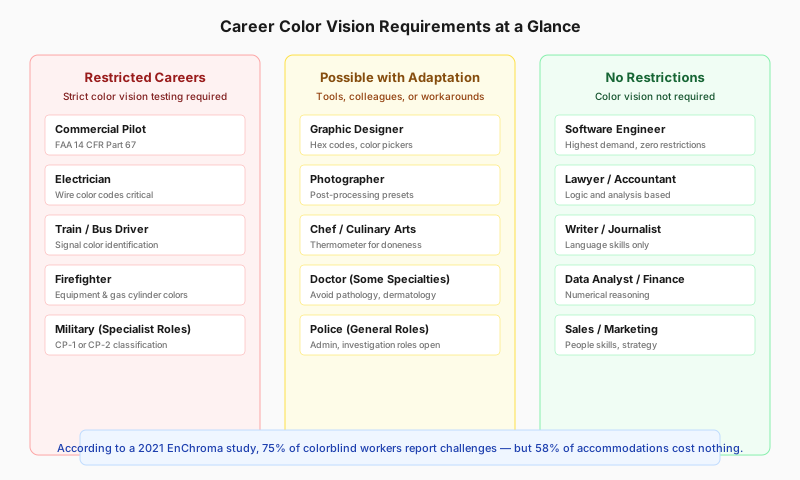
Overview of career categories by color vision requirement level. Source data: FAA, US DOL, Colour Blind Awareness.
The Gray Area: Design, Photography, and Medicine
Can you be a designer if you are colorblind? Yes — and many successful designers are. The key is understanding where color matters in your workflow and building systems to manage it.
Graphic and Web Design
No formal restriction exists for colorblind designers in any country. Many professionals rely on hex codes, established color palettes, and accessibility tools like Adobe Color or WebAIM Contrast Checker. A 2019 study published in the Journal of Usability Studies found that colorblind designers scored higher on accessibility compliance in UI reviews than their peers with normal vision — likely because they intuitively avoid designs that depend solely on color differentiation. This aligns with best practices for red-green deficiency awareness in UI/UX design.
Photography
Colorblind photographers exist and thrive. Post-processing presets, histogram tools, and collaboration with editors handle color grading. Composition, lighting, and subject matter — the elements that make photography compelling — are independent of color perception.
Medicine
Most medical specialties (general practice, psychiatry, surgery, radiology) are accessible. However, specialties like dermatology and pathology rely heavily on subtle color differences in tissue and skin. A paper in the British Journal of General Practice noted that colorblind clinicians may miss erythema or cyanosis in patients, but compensate effectively through other clinical signs and instrument readings. Those with significant red-green deficiency should consider which specialty best suits their visual profile.
Culinary Arts
While judging meat doneness by color alone can be tricky, a food thermometer solves this completely. Taste, texture, aroma, and plating technique matter far more than color discrimination in professional kitchens.
Color Blindness in the Workplace: What the Data Shows
A 2021 workforce survey by EnChroma (published via BusinessWire, n=810 colorblind workers) quantified the day-to-day impact of CVD in professional settings:
- 75% report that color blindness slows them down at work.
- 65% have trouble interpreting color-coded charts, graphs, or materials.
- 75% ask coworkers to verify colors at least once a week; 31% do so almost daily.
- 58% of workplace accommodations cost the employer nothing at all.
The Job Accommodation Network (JAN), a service of the US Department of Labor, confirms that the average cost of accommodating employees with disabilities is under $500, and the majority of accommodations are free. For colorblind workers, this typically means adding text labels to color-coded systems, using patterns alongside colors in charts, or switching to colorblind-friendly palettes in shared documents.
According to the Colour Blind Awareness organisation, any workplace with more than 12 male employees statistically has at least one colorblind staff member — yet most companies have no formal accommodation policy in place.
Practical Tips for Colorblind Job Seekers
Know which test your target career uses. Different employers use different screening tools. The Ishihara plates are the most common initial screen, but many agencies offer the Farnsworth D-15 or FALANT lantern tests as alternatives. If you fail the primary screening, always ask about secondary options — the Ishihara is considered overly strict for mild cases by many occupational health researchers. You can practice with our Ishihara test to understand your baseline.
Understand the severity of your condition. Mild deuteranomaly (the most common type, affecting about 5% of males according to NIH data) is very different from complete dichromacy. Research published in Ophthalmic and Physiological Optics found that individuals with mild anomalous trichromacy pass the Farnsworth D-15 at rates above 90%. A Farnsworth-Munsell 100 Hue test can help you understand exactly where your discrimination is weakest.
Disclosure is your choice. For office jobs, you are not legally required to disclose CVD. For safety-critical roles, medical exams will identify it regardless. In the US, recent case law (EEOC guidance, 2022) suggests color blindness may qualify as a disability under the ADA if it substantially limits a major life activity, meaning employers must provide reasonable accommodations upon request.
Use technology to your advantage. Color picker browser extensions, high-contrast editor themes, colorblind-simulation tools like Color Oracle, and specialized glasses from companies like EnChroma can bridge many gaps in daily work.
Frame your CVD as an asset when relevant. In design and product roles, having a team member who inherently understands accessibility challenges is valuable. WCAG 2.1 guidelines explicitly state that information should never be conveyed by color alone — a principle you understand firsthand.
Career FAQs
Not Sure About Your Color Vision?
Before ruling out a career, check the type and severity of your color blindness. Mild cases often qualify for more roles than you might expect.
Sources
- National Eye Institute. "Color Blindness." nei.nih.gov
- FAA. "Color Vision Testing FAQs." 14 CFR Part 67 (2025 update)
- EnChroma / BusinessWire. "75% of Color Blind People Experience Challenges at Work." July 2021 (n=810)
- Job Accommodation Network (JAN), US Department of Labor. "Workplace Accommodations: Low Cost, High Impact." askjan.org
- Colour Blind Awareness. "Careers and the Workplace." colourblindawareness.org
- Federal Railroad Administration. 49 CFR Part 240 — Locomotive Engineer Certification
- NFPA. Hazardous Materials Placard Color Standards