
Can Colorblind People Drive? License Rules in 20+ Countries
"If you can't tell red from green, you can't drive." This myth has worried millions of young people approaching their first driving test. The reality is far more reassuring.
Color vision deficiency (CVD) affects approximately 8% of males and 0.5% of females worldwide, according to the National Eye Institute. That translates to over 300 million people globally — and the vast majority of them hold valid driver's licenses. In fact, no country in the world with a significant driving population has reported higher accident rates among colorblind drivers compared to those with normal color vision.
This guide breaks down the driving rules for colorblind individuals across more than 20 countries, explains how traffic infrastructure is designed for accessibility, and provides practical strategies for navigating the road with confidence.
How Traffic Lights Are Designed for Colorblind Drivers
The widespread fear that colorblind drivers will run red lights ignores a fundamental fact: traffic signals were never designed to rely on color alone. International traffic engineering standards build in multiple redundant cues specifically so that color-deficient drivers can navigate safely.
Position-Based Identification
The Manual on Uniform Traffic Control Devices (MUTCD) published by the US Federal Highway Administration mandates that vertical traffic signals always place red at the top, yellow in the middle, and green at the bottom. For horizontal signals, red is on the left (in left-to-right reading countries). This global convention means colorblind drivers can identify signals by position rather than hue.
Brightness and Wavelength Differences
Modern LED traffic lights emit distinct wavelengths that produce brightness differences visible even to those with red-green color blindness. To a protan (red-blind) driver, the red light appears significantly dimmer and darker than the green signal, providing an additional identification cue beyond position.
Shape-Based Innovations
Some jurisdictions have added shape cues to traffic signals. Canada's eastern provinces (notably Nova Scotia and Prince Edward Island) use differently shaped signal lenses: a square frame for red, a diamond for yellow, and a circle for green. In 2009, South Korean designer Ji-youn Kim developed the UniSignal concept, embedding a triangle, diamond, and circle within standard traffic lights to indicate stop, caution, and go.
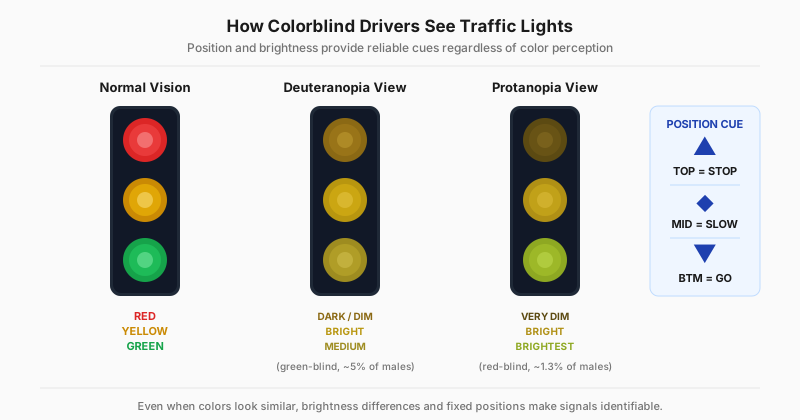
Traffic light appearance across different color vision types. Position (top/middle/bottom) and brightness differences remain consistent cues for all drivers.
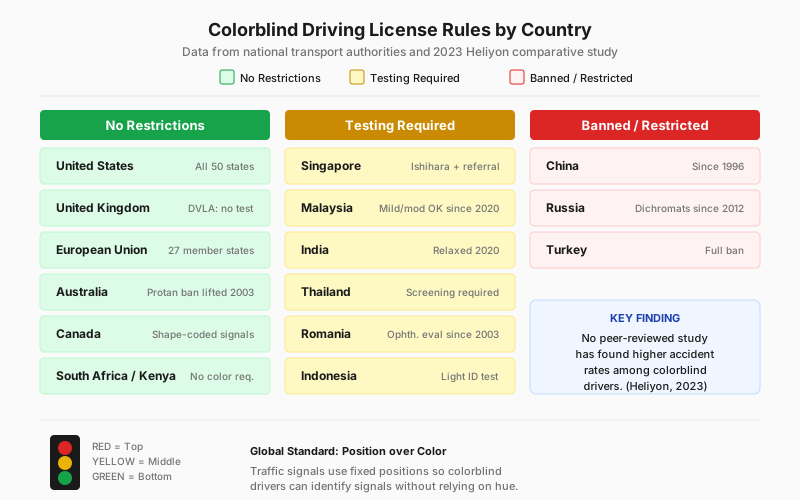
Global overview of colorblind driving regulations. Data compiled from national transport authorities and the 2023 ASEAN comparative study published in Heliyon.
Country-by-Country License Rules for Colorblind Drivers
A 2023 peer-reviewed study published in Heliyon compared colour vision regulations for driving across ASEAN nations and the wider world. The researchers found no universal standard — regulations range from complete prohibition to no requirements whatsoever. Here is the current state by region:
No Restrictions (Private License)
In these countries, color blindness does not prevent you from obtaining a standard private vehicle license:
- United States — No state prohibits colorblind drivers. Massachusetts is the only state that explicitly mentions color vision in licensing requirements, but drivers can compensate by memorizing signal positions. The FMCSA vision standards focus on acuity (20/40 minimum), not color perception, for private licenses.
- United Kingdom — Color blindness is not a disqualifier. The DVLA does not test for color vision during standard licensing.
- European Union — The EU's First Council Directive on driving licenses (1980) explicitly excluded colour vision requirements. This applies across all 27 member states for Group 1 (private) licenses.
- Australia and New Zealand — No restrictions for private licenses. Australia revoked its protan restriction for commercial licenses in 2003 after evidence showed no safety impact.
- Canada — No federal or provincial ban. Eastern provinces add shape-coded signals for additional accessibility.
- South Africa and Kenya — Neither country specifies color vision requirements for licensing.
Testing Required (Conditional Pass)
These countries require some form of color vision screening, but passing is achievable for most colorblind individuals:
- Singapore — Applicants must pass an Ishihara test. Those who fail are referred to an ophthalmologist who may administer a simpler color identification test (identifying red, green, and amber circles). After passing, medical authorization is granted.
- Malaysia — A 15-minute test checks for deuteranomaly, protanomaly, protanopia, and deuteranopia using Ishihara plates. Since 2020, mild to moderate colorblind applicants can obtain licenses.
- India — In June 2020, India relaxed its blanket ban. Only individuals with strong CVD are now disqualified; mild and moderate cases pass the medical requirements.
- Thailand — Applicants must pass a color blindness screening. Those who fail may be disqualified, though this policy has faced domestic criticism from medical professionals.
- Romania — Removed color blindness from its disqualifying conditions list in 2003. An ophthalmologist evaluation is now required, but approval is routine for most CVD types.
- Indonesia — Requires a basic light-identification test during the medical screening process.
Banned or Heavily Restricted
A small number of countries still prohibit colorblind individuals from driving:
- China — Since 1996, individuals with color blindness cannot test for a driver's license. Those with "color weakness" (mild deficiency) may qualify if they pass a hospital-issued certificate test before the written exam.
- Russia — Since 2012, individuals with dichromacy (complete absence of one cone type) are banned. Since 2016, all forms of color blindness are reported as grounds for denial.
- Turkey — It is illegal for colorblind individuals to hold a driver's license. The law was enacted based on the assumption that colorblind drivers cannot interpret traffic signals.
Commercial vs. Private Licenses: Where the Line Is Drawn
Even in countries with no restrictions for private driving, the rules tighten considerably for commercial vehicle operators. The logic is straightforward: commercial drivers operate larger vehicles, carry passengers, and spend significantly more hours on the road.
- US Commercial Driver's License (CDL) — The FMCSA requires commercial drivers to "recognize the colors of traffic signals and devices showing standard red, green, and amber." Colorblind applicants may be denied without a Federal Vision Exemption, which requires demonstrating a safe driving record.
- Bus and Passenger Transport — Most countries with Group 2 license categories (buses, large trucks) require color vision testing as part of the medical exam. The reasoning is passenger safety liability.
- Rail and Aviation (Not Driving, but Related) — Train drivers and pilots face the strictest requirements. The FAA requires color signal identification under 14 CFR Part 67. For more on restricted careers, see our jobs for colorblind people guide.
What the Research Says About Safety
Critics of colorblind driving bans consistently point to one fact: no peer-reviewed study has found significantly higher accident rates among colorblind drivers. A 2023 literature review in Heliyon (ScienceDirect) concluded that "the current evidence does not support a strict exclusion of all colour-deficient individuals from driving."
The same review noted that while color-deficient drivers may face "mild challenges" in certain lighting conditions (particularly at dusk or in fog), their learned compensatory strategies — relying on position, brightness, and contextual cues — effectively neutralize any increased risk. The global trend over the past two decades has been toward relaxing, not tightening, colour vision regulations for driving.
5 Practical Tips for Colorblind Drivers
Whether you have mild deuteranomaly or more significant protanopia, these strategies will help you drive safely and confidently:
- Memorize signal positions, not colors — Top or left is always stop. Bottom or right is always go. This is the single most important adaptation. Practice identifying position instantly during your daily commute until it becomes automatic.
- Watch the traffic flow at unfamiliar intersections — If you approach a signal you cannot read confidently (perhaps a single flashing light), observe what other vehicles are doing before proceeding. Defensive driving protects everyone.
- Treat ambiguous flashing lights as stop signals — Flashing yellow (caution) and flashing red (stop) can appear similar to some colorblind drivers. When uncertain, stopping is always the safer option.
- Use technology as a backup — Navigation apps like Google Maps and Waze provide audio turn-by-turn directions that reduce reliance on visual signals. Some newer vehicles include heads-up displays that label traffic signal states.
- Know your specific type before your test — Understanding whether you have deuteranomaly, protanomaly, or tritanomaly helps you anticipate which signals will be hardest for you. Take our free Ishihara test to identify your type, then follow up with the Farnsworth-Munsell 100 Hue test to understand your severity level.
What Happens at the DMV Vision Test?
Many applicants worry that they will be denied a license at the vision screening. In practice, the process is rarely an obstacle for colorblind individuals in countries that permit it. Here is what to expect in the US:
- Visual acuity is the primary test — The standard Snellen chart measures distance vision (20/40 minimum required). This has nothing to do with color.
- Color screening varies by state — Some states ask you to identify colored dots or circles (red, green, amber). Others simply ask whether you can see which position on a traffic signal is illuminated.
- Failing color screening is not automatic disqualification — In most states, you will be referred to an ophthalmologist who can issue a medical waiver or affidavit confirming that you can distinguish signal positions.
If you want to understand your baseline before the test, our red-green color blind test simulates the type of screening many DMV offices use.
Does the Type of Color Blindness Matter?
Not all color vision deficiencies affect driving equally. The genetics behind color blindness determine which specific wavelengths you struggle with:
- Deuteranomaly (most common, ~5% of males) — Reduced green sensitivity. Traffic signals may appear slightly washed out, but position identification remains easy. Most individuals with this type pass DMV screenings without issue.
- Protanopia/Protanomaly (~1.3% of males) — Reduced or absent red sensitivity. The red signal appears notably darker/dimmer, which paradoxically can make it easier to distinguish from green by brightness alone.
- Tritanopia (extremely rare, <0.01%) — Blue-yellow confusion. Has minimal impact on driving since traffic signals use red, amber, and green — not blue.
- Achromatopsia (complete color blindness) — Extremely rare (1 in 30,000). Individuals see only grayscale and often have light sensitivity and reduced acuity. This is the only form that may genuinely complicate driving, primarily due to the light sensitivity rather than color perception.
Frequently Asked Questions
Sources
- National Eye Institute (NIH) — Color blindness prevalence data and clinical overview
- Heliyon / ScienceDirect (2023) — “Colour vision restrictions for driving: an evidence-based perspective on regulations in ASEAN countries compared to other countries”
- FHWA Manual on Uniform Traffic Control Devices (MUTCD) — US federal standards for traffic signal placement and design
- FMCSA Vision Requirements — Federal Motor Carrier Safety Administration visual standards for commercial drivers
- Colour Blind Awareness Organisation — UK-based charity providing driving guidance for colorblind individuals
- ScienceDirect — Heliyon Research Paper — Full text of the 2023 comparative study on colour vision driving regulations worldwide
Know Your Color Vision Before Your Driving Test
Understanding your specific type and severity helps you prepare for any vision screening. Most colorblind people pass standard driving tests without difficulty.