
Color Blindness FAQ: Everything You Need to Know
50+ questions about color vision deficiency — answered with data, sources, and links to our free tests.
Jump to a section
The Basics
What is color blindness?
Color blindness — medically called color vision deficiency (CVD) — is a condition where a person cannot distinguish certain colors or color differences the way most people do. It is usually caused by abnormal or missing cone photoreceptors in the retina of the eye.
Critically, most color blind people can see colors. They see a narrower range of distinguishable hues, not a gray world. Only achromatopsia (complete color blindness) results in grayscale vision, and that affects roughly 1 in 30,000 people[1].
How common is color blindness?
Approximately 300 million people worldwide have some form of color blindness — about 4% of the global population. It affects 8% of men (1 in 12) and 0.5% of women (1 in 200) of Northern European descent. Rates vary by ethnicity: ~5% in East Asian males, ~4% in African males, and ~2% in Indigenous Australian males[2].
How do color blind people see the world?
Most color blind people see blues, yellows, and whites perfectly well. The confusion is specific to certain color pairs depending on the type of CVD:
- Red-green color blind: Reds, greens, browns, and oranges look similar. Purple may be confused with blue.
- Blue-yellow color blind: Blues and greens look similar. Yellows appear as pale pink or gray.
- Total color blindness: The world appears entirely in shades of gray (extremely rare).
What do color blind people see when they look at a rainbow?
A person with red-green CVD sees a rainbow with about 2–3 distinct bands instead of the usual 7. The red, orange, and yellow portions merge into a single yellowish band, green appears muted, and the blue-violet end looks relatively normal. To someone with tritanopia (blue-yellow blindness), the blue end fades while the red-yellow portion remains vivid.
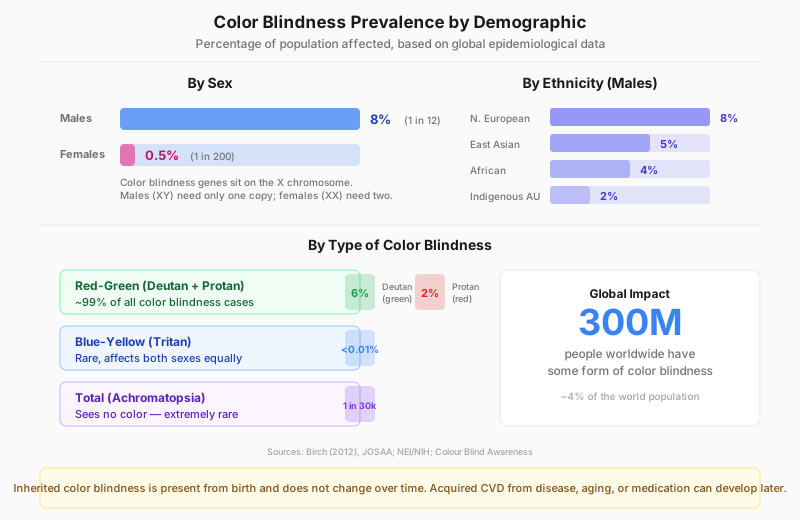
Color blindness prevalence varies significantly by sex, ethnicity, and type.
Types of Color Blindness
What are the different types of color blindness?
There are three main categories, each with subtypes. For a deep dive, see our complete guide on types of color blindness.
| Category | Type | Cone Affected | Prevalence (Males) |
|---|---|---|---|
| Red-Green | Deuteranomaly | Green (weak) | ~5% |
| Deuteranopia | Green (absent) | ~1.5% | |
| Protanomaly | Red (weak) | ~1% | |
| Protanopia | Red (absent) | ~1% | |
| Blue-Yellow | Tritanomaly | Blue (weak) | Very rare |
| Tritanopia | Blue (absent) | ~0.01% | |
| Monochromacy | Achromatopsia | All cones | 1 in 30,000 |
What is the most common type?
Deuteranomaly (reduced green sensitivity) is by far the most common, accounting for about 50% of all color blindness cases. Combined, the four red-green types make up roughly 99% of all color vision deficiency. You can check your specific type with our red-green color blind test or blue-yellow test.
What is the difference between inherited and acquired color blindness?
| Feature | Inherited | Acquired |
|---|---|---|
| Onset | Present from birth | Develops later in life |
| Cause | Genetic (X-linked) | Disease, medication, aging, injury |
| Progression | Stable (does not worsen) | May worsen over time |
| Both eyes? | Always both equally | Can affect one eye or both |
| Common type | Red-green | Blue-yellow |
| Reversible? | No | Sometimes (if underlying cause treated) |
Causes & Genetics
Why are more men color blind than women?
The genes for red and green cone photopigments sit on the X chromosome. Men have one X (from their mother) and one Y chromosome. If the single X carries a defective color gene, they are color blind — there is no backup. Women have two X chromosomes: a defective gene on one is usually compensated by a normal gene on the other. This is why ~8% of men but only ~0.5% of women are affected. For more details, see our guide on the genetics of color blindness.
Can women be color blind?
Yes. A woman is color blind when she inherits the defective gene from both parents — a color blind father and a carrier mother. Each daughter of this pairing has a 50% chance of being color blind. Women can also be carriers (one defective copy, one normal) without being color blind themselves. About 15% of women of European descent carry one copy of a red-green CVD gene[3].
Can color blindness skip a generation?
Yes — and this is one of the most common inheritance patterns. A color blind grandfather passes his X chromosome to all his daughters, making them carriers (but not color blind). If a carrier daughter has a son, that son has a 50% chance of being color blind. So the condition skips from grandfather to grandson through a carrier mother. This is a classic X-linked recessive inheritance pattern.
Can you become color blind later in life?
Yes. Acquired color vision deficiency can develop from:
- Eye diseases: Cataracts, glaucoma, macular degeneration, diabetic retinopathy
- Medications: Hydroxychloroquine (Plaquenil), ethambutol, some chemotherapy drugs
- Aging: The lens yellows over time, reducing blue light transmission
- Head injury: Damage to the visual cortex or optic nerve
- Chemical exposure: Solvents like styrene and carbon disulfide
Acquired CVD often affects blue-yellow discrimination first (unlike inherited CVD which is mostly red-green) and may affect only one eye[4].
Can color blindness get worse over time?
Inherited: No. It remains the same from birth to death because it is determined by the genetic structure of your cone cells. Acquired: Yes, it can worsen as the underlying condition progresses. If your color vision changes noticeably, see an eye doctor — it may indicate a treatable medical issue.
Testing & Diagnosis
How do I know if I am color blind?
Common signs include: confusing red and green items (traffic lights, ripe vs. unripe fruit), difficulty with color-coded information (charts, maps, wires), being told you misidentified a color, or struggling in dim lighting where color cues are reduced. The fastest way to check is to take a free online Ishihara color blind test — it takes under 5 minutes.
What is the Ishihara test?
The Ishihara test is the world's most widely used color blind screening test. It uses circular plates filled with colored dots of varying sizes. Hidden within the dots is a number that people with normal color vision can see but color blind individuals cannot (or see a different number). The standard test has 38 plates; the screening version uses 14. Take our free online Ishihara test to screen yourself.
How accurate are online color blind tests?
Online Ishihara-style tests provide approximately 95% accuracy for screening red-green color blindness when taken under proper conditions (daylight or calibrated display, no glare, screen brightness at standard levels). They are excellent for detecting whether you have a color vision deficiency. However, for precise classification of type and severity, clinical tests like the Farnsworth-Munsell 100 Hue test or anomaloscope are more accurate.
What other color blind tests exist?
| Test | What It Does | Best For |
|---|---|---|
| Ishihara | Dot plates with hidden numbers | Screening red-green CVD |
| Farnsworth-Munsell 100 Hue | Sort 85 colored caps by hue | Severity grading, all types |
| Farnsworth D-15 | Sort 15 colored caps | Quick clinical assessment |
| Lantern Test | Identify colored lights | Military, aviation, maritime |
| Anomaloscope | Match yellow by mixing red + green light | Gold standard clinical diagnosis |
| HRR Plates | Geometric symbols in dot patterns | Children, tritan detection |
At what age can you test for color blindness?
Shape-based tests (CVTME, HRR) can be used from age 4. The standard Ishihara test works from age 5–6 when children can read numbers. For toddlers under 4, behavioral observation is the best approach. See our guide on early signs of color blindness in children for age-by-age indicators. We also have a kids color blind test designed for younger users.
Treatment & Correction
Can color blindness be cured?
Inherited color blindness cannot be cured with current technology. The condition is determined by the physical structure of cone cells, which cannot be altered by medication, surgery, or therapy. However, acquired CVD (from disease or medication) may improve if the underlying cause is treated — for example, cataract surgery can restore color perception lost to lens yellowing.
Do color blind glasses work?
Color-correcting glasses (like EnChroma and Pilestone) use spectral notch-filter technology to block overlapping wavelengths between red and green cones, increasing the contrast between colors. They can significantly improve color discrimination for people with mild-to-moderate anomalous trichromacy (protanomaly or deuteranomaly). They do not work for dichromats (people completely missing a cone type) or for blue-yellow CVD. For a detailed breakdown, see our guide on how color blind glasses work.
Will gene therapy cure color blindness in the future?
Possibly. Researchers at the University of Washington (Jay and Maureen Neitz) successfully restored color vision in squirrel monkeys using AAV gene therapy, and have partnered with a biotech firm to develop human treatments[5]. The challenge is delivering the gene to billions of existing cone cells. Human clinical trials for red-green color blindness have not yet begun as of 2026, but the approach is considered scientifically viable.
What apps or tools help color blind people?
- OS color filters: iOS (Settings → Accessibility → Color Filters), Android (Accessibility → Color correction), Windows (Color Filters)
- Browser extensions: Colorblindly, Daltonize — shift page colors to more distinguishable palettes
- Color identification apps: Color Blind Pal, Color Grab — use your phone camera to identify colors in real time
- Design tools: Coolors contrast checker, Coblis simulator — help designers create accessible content
Daily Life & Practical Tips
Can color blind people drive?
Yes — the vast majority of color blind people drive safely and legally. Traffic lights use a standardized position (red on top, green on bottom) and brightness differences that color blind drivers learn to read. Most countries, including the US, UK, Canada, and Australia, do not restrict driving licenses for color blind individuals. For country-by-country rules, see our guide on driving with color blindness.
How do color blind people pick matching clothes?
Common strategies include: labeling clothes with color tags, using smartphone color-identification apps, buying neutral colors (navy, gray, black, white) that always match, organizing the closet by color with help from a friend, and using apps like "Is this my color?" before purchasing.
Can color blind people be good at art?
Absolutely. Many celebrated artists worked with color vision deficiency. Charles Meryon (19th-century printmaker) is believed to have been color blind — and his engravings are masterpieces. Color blind artists often develop a strong sense of value (light/dark), composition, and texture that compensates for reduced hue discrimination. Digital tools also allow working with exact hex/RGB values rather than visual matching.
Are dogs color blind?
Not in the way humans are. Dogs are dichromats — they have two types of cone cells (blue and yellow) instead of the three that humans have. This means dogs see the world roughly like a human with deuteranopia (green-blind): they perceive blues and yellows well but cannot distinguish red from green. However, dogs compensate with far superior motion detection and night vision.
Are there famous people who are color blind?
Yes. Notable color blind individuals include Mark Zuckerberg (chose Facebook's blue theme because blue is his richest color), Bill Clinton, Prince William, Christopher Nolan (director), Keanu Reeves, Eddie Redmayne, and Fred Rogers (Mr. Rogers). John Dalton, the chemist who first described color blindness scientifically in 1794, was himself color blind — which is why the condition is sometimes called "Daltonism."
Careers & Legal
What jobs are restricted for color blind people?
Jobs that require normal color vision include: commercial airline pilots, some military roles (depending on branch), electricians (color-coded wiring), train drivers, marine navigators, and certain clinical laboratory positions. However, most careers have no color vision requirement. For a comprehensive breakdown, see best jobs for colorblind people and military color blind requirements.
Is color blindness a disability?
It depends on the legal jurisdiction and severity:
- United States: Generally NOT classified as a disability under the ADA unless it "substantially limits a major life activity." Most courts have ruled that common red-green CVD does not meet this threshold.
- United Kingdom: The Equality Act 2010 may cover severe cases as a "physical impairment."
- Practical reality: Most color blind people function normally in daily life without accommodations. The condition is better described as a "variation" than a disability for the vast majority.
Can my employer fire me for being color blind?
In most countries, no — unless color vision is a genuine occupational requirement for the specific role. An employer cannot fire or refuse to hire someone for color blindness if the job does not require color discrimination. However, for safety-critical roles (pilot, electrician, EOD technician), color vision requirements are legally defensible as a bona fide occupational qualification.
Children & Education
How do I know if my child is color blind?
Watch for: confusing red and green items, difficulty with color-by-number activities, unusual crayon choices, frustration with color-coded worksheets, or being labeled as "slow" when only color tasks are the issue. For a detailed age-by-age guide, see our article on early signs of color blindness in children.
Should I tell my child they are color blind?
Yes — the earlier the better. Research shows that children who understand their color vision difference develop better coping strategies and higher self-confidence than those who discover it later. Frame it as a difference (like being left-handed), not a deficiency. Teach them to use context clues (position, brightness, labels) instead of relying on color alone.
What school accommodations can I request?
- Use text labels or patterns — not color alone — on charts and graphs
- Avoid red markers on green paper (or similar low-contrast combinations)
- Seat the child where whiteboard glare is minimized
- Allow color identification apps on school tablets
- In sports, use both color and pattern/number on bibs
In the US, children with documented CVD may qualify for a Section 504 accommodation plan if the condition substantially limits learning[6].
Myths & Misconceptions
Myth: Color blind people see in black and white.
Reality: Fewer than 0.003% of people have achromatopsia (total color blindness). The other 99.99%+ of color blind people see colors — just a narrower range. A person with deuteranomaly (the most common type) sees most of the same colors you do, with reduced ability to separate reds and greens.
Myth: You can train yourself out of color blindness.
Reality: Inherited CVD is caused by the physical structure of cone cells in your retina. No amount of practice, vitamins, exercises, or "brain training" can change the photopigments in your cones. Beware of products claiming to cure color blindness through training.
Myth: Color blind people cannot tell ANY colors apart.
Reality: Color blindness is type-specific. A person with red-green CVD sees blue, yellow, and white perfectly. A person with tritanopia sees red and green perfectly but confuses blue and green. Each type has specific confusion pairs, not a global color deficit.
Myth: Only men can be color blind.
Reality: Women can be color blind — it is just much less common (0.5% vs 8%). The confusion arises because the genes are X-linked and women need two copies to be affected. But millions of women worldwide are color blind.
Myth: Color blind glasses "fix" color blindness.
Reality: Color-correcting glasses enhance contrast between certain colors but do not restore normal color vision. They work best for mild-to-moderate anomalous trichromacy and have no effect on complete dichromacy. Colors look different with the glasses on, but this is enhanced discrimination — not "normal" vision.
Key Takeaway
Color blindness affects 300 million people worldwide — about 1 in 12 men and 1 in 200 women. It is overwhelmingly a mild, manageable condition. Most color blind people see a rich world of color; they simply distinguish fewer shades in specific parts of the spectrum.
The best first step: know your status. Take our free Ishihara color blind test to screen for red-green CVD in under 5 minutes. If you want more detail, follow up with our Farnsworth-Munsell 100 Hue test for severity grading.
Sources
- National Eye Institute. "Color Blindness." nei.nih.gov
- Birch, J. (2012). "Worldwide prevalence of red-green color deficiency." Journal of the Optical Society of America A, 29(3), 313-320. PubMed
- Colour Blind Awareness. "Inherited Colour Vision Deficiency." colourblindawareness.org
- American Academy of Ophthalmology. "What Is Color Blindness?" aao.org
- University of Washington / WaNPRC. "Scientists May Have Colorblindness Cure." wanprc.uw.edu
- US Department of Education. "Protecting Students with Disabilities — Section 504." ed.gov
- Cleveland Clinic. "Color Blindness." clevelandclinic.org
Quick Answers
Related Articles
- Why People See “The Dress” Differently
- Types of Color Blindness: A Complete Guide to Every Form of CVD
- The Genetics of Color Blindness: Why Men Are More Affected
- How Do Color Blind Glasses Work? Science, Brands & Buying Guide
- Is My Child Color Blind? Age-by-Age Signs Parents Should Know
- Best Jobs for Colorblind People (and Careers to Avoid)