
Can You Join the Military If You Are Color Blind? Every Branch, Test & Job Explained
A complete guide to color vision requirements for the U.S. Army, Navy, Air Force, Marines, Coast Guard — plus international military rules.
You want to serve your country — but you just found out you are color blind. Does that mean your military career is over before it starts?
The short answer: no. Color blindness does not disqualify you from military service. Every U.S. branch accepts applicants with color vision deficiency (CVD). However, the specific jobs available to you — and the tests you must pass — vary significantly by branch, severity, and whether you are enlisting or pursuing a commission.
This guide covers everything: the MEPS testing process, which color blind tests each branch uses, specific jobs open and restricted for color blind service members, the waiver process, and military color vision rules in the UK, Canada, India, and Australia. If you have not already, take our free Ishihara color blind test to understand your color vision before going to MEPS.
How the Military Tests for Color Blindness (MEPS Process)
Every military applicant undergoes a medical screening at MEPS (Military Entrance Processing Station). Color vision testing is part of this exam. Here is what happens step by step:
Step 1: PIP (Ishihara) screening
Everyone starts with the Pseudoisochromatic Plate (PIP) test — essentially the same as the Ishihara color blind test you can take online. You are shown 14 dot-pattern plates containing hidden numbers. You need 12 out of 14 correct to pass. If you pass, you are classified as having normal color vision and all jobs are available to you.
Step 2: Secondary test (branch-dependent)
If you fail the PIP, what happens next depends on which branch you are joining. This is where the branches diverge significantly:
| Branch | Screening | Secondary Test | Tertiary Test |
|---|---|---|---|
| Army | PIP (Ishihara) | FALANT | Vivid Red/Green |
| Navy | PIP (Ishihara) | WCCVT / FALANT | — |
| Air Force | PIP (Ishihara) | CCT (pilots only) | — |
| Marines | PIP (Ishihara) | FALANT | — |
| Coast Guard | PIP (Ishihara) | FALANT / Williams / WCCVT | — |
| Space Force | PIP (Ishihara) | Follows USAF standards | — |
Good news
About 70% of people who fail the PIP pass the FALANT. The PIP (Ishihara plates) is a screening test with high sensitivity — it catches many people with mild color deficiency who function perfectly well with real-world colors. The FALANT uses actual colored lights (red, green, white) and better reflects practical color discrimination ability.
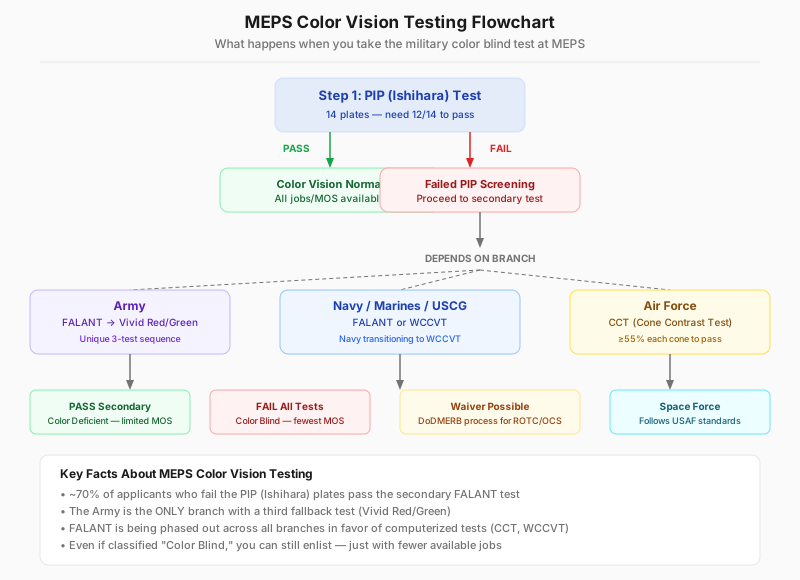
The MEPS color vision testing pathway. Each branch uses different secondary tests after the initial PIP (Ishihara) screening.
Understanding Each Color Blind Test
PIP (Pseudoisochromatic Plates / Ishihara)
The universal first-line screening. You see colored dot plates with hidden numbers — identical to the Ishihara test on this site. The military uses 14 plates and requires 12 correct. It primarily detects red-green deficiency. Because it is a screening test, it is intentionally sensitive — meaning it catches mild cases that may not affect real-world performance.
FALANT (Farnsworth Lantern Test)
Developed during World War II for the U.S. Navy. The FALANT shows pairs of colored lights (red, green, or white) from a distance. You identify which colors you see. To pass, you need zero errors in 9 pairs, or 2 or fewer errors in 18 pairs. The FALANT tests practical color discrimination using actual light sources — similar to the lantern test you can practice on our site.
Important: FALANT is being phased out
The FALANT has only ~25% sensitivity for detecting color vision deficiency. A 2022 study in Military Medicine (Gao et al.) found that FALANT passed individuals with moderate-to-severe CVD who failed computerized tests[1]. DoDMERB no longer accepts FALANT results for Service Academy and ROTC applicants. All branches are transitioning to computerized alternatives.
CCT (Cone Contrast Test)
A computerized test that measures sensitivity for each cone type independently — red (L-cone), green (M-cone), and blue (S-cone). Used primarily by the Air Force, especially for pilot candidates. The current passing threshold is 55% or higher for each cone type (lowered from the previous 75% standard). The CCT provides more granular data than the PIP or FALANT and is increasingly adopted across all branches.
WCCVT (Waggoner Computerized Color Vision Test)
The Navy and Coast Guard's replacement for the FALANT. The WCCVT grades results as Normal, Mild, Moderate, or Severe — giving a more detailed picture than the binary pass/fail of older tests. It runs on a standard computer display and takes about 5 minutes.
Vivid Red/Green Test (Army only)
Unique to the U.S. Army. This is a third-chance test offered only after failing both the PIP and FALANT. You identify plates of black/white, red, and green. You need 5 out of 10 correct to pass. This is the Army's most lenient color test and determines whether you are classified as "Color Deficient" (limited jobs) versus "Color Blind" (fewest jobs).
| Feature | PIP / Ishihara | FALANT | CCT | WCCVT |
|---|---|---|---|---|
| Type | Paper plates | Light lantern | Computer | Computer |
| What it measures | R/G deficiency | R/G/W light ID | Cone-specific contrast | Multi-type CVD |
| Pass criteria | 12/14 plates | 0 or ≤2 errors | ≥55% per cone | Mild or better |
| Sensitivity | High | Low (~25%) | High | High |
| Status | Active (all branches) | Being phased out | Growing (USAF primary) | Growing (USN/USCG) |
| Used by | All branches | Army, Navy, Marines | Air Force, Space Force | Navy, Coast Guard |
Color Vision Requirements by U.S. Military Branch
U.S. Army
The Army has the most opportunities for color blind applicants thanks to its unique three-test sequence. After failing PIP, you take the FALANT. If you fail that, you still get the Vivid Red/Green test. The Army classifies applicants into three categories:
- Color Safe — passed PIP or FALANT. Most jobs available.
- Color Deficient — failed PIP and FALANT, passed Vivid Red/Green. Limited jobs.
- Color Blind — failed all three tests. Fewest jobs, but you can still enlist.
Army MOS open to color blind soldiers:
| MOS Code | Job Title | Min. Color Vision |
|---|---|---|
| 42A | Human Resources Specialist | Color Blind OK |
| 27D | Paralegal Specialist | Color Blind OK |
| 36B | Financial Management Technician | Color Blind OK |
| 92A | Automated Logistical Specialist | Color Deficient OK |
| 17C | Cyber Operations Specialist | Color Deficient OK |
| 38B | Civil Affairs Specialist | Color Deficient OK |
| 68G | Patient Administration Specialist | Color Deficient OK |
| 42R | Army Musician | Color Blind OK |
Restricted Army jobs include Aviation (15-series), Electronics (25-series), Special Operations, EOD (89D), and Airborne qualification. Red-green deficient soldiers cannot attend Airborne school.
U.S. Navy
The Navy is transitioning from FALANT to the WCCVT (Waggoner Computerized Color Vision Test). Normal color vision is required for ROTC commissions — waivers are rare and typically limit you to Line Duty Officer roles.
Navy ratings open to color blind sailors: Culinary Specialist (CS), Religious Programs Specialist (RP), Legalman (LN), Yeoman (YN), Aviation Maintenance Administrationman (AZ), Hospital Corpsman (HM).
Restricted Navy ratings: Electronics Technician (ET), Air Traffic Controller (AC), Aviation Boatswain's Mate (AB), EOD, Electrician's Mate (EM), Quartermaster (QM), Nuclear Field, SEAL, SWCC.
U.S. Air Force
The Air Force relies on the PIP as a pass/fail screening. It does not use the FALANT. For pilot, navigator, and Air Battle Manager (ABM) candidates, the Cone Contrast Test (CCT) is administered with a minimum of 55% per cone. The Air Force recently lowered this from 75%, opening more opportunities for applicants with mild CVD.
Air Force AFSCs open to color blind airmen: Services (3F1X1), Religious Affairs (5R0X1), Materiel Management (2S0X1), Health Services Management (4A0X1), Aviation Resource Management (1C0X2), Cryptologic Language Analyst (1N3X1), HUMINT (1N0X1), Operations Management (1C1X1).
Restricted Air Force AFSCs: All rated positions (pilot, navigator, ABM), Flight Engineer, Cybersecurity (1B4X1), Airfield Management, Biomedical Equipment Tech, Radar & Weather Systems.
Tip for Air Force applicants
Check the AFECD (Air Force Enlisted Classification Directory). Search for "color vision" to find which AFSCs specifically do and do not require normal color vision. The document is updated annually and is the authoritative source.
U.S. Marine Corps
The Marine Corps is the most flexible branch for color blind applicants. Notably, Infantry (0311) does not require normal color vision in the Marines — unlike the Army. The Marine Corps also has no color vision requirement for ROTC (the Marine Corps Option), making it the best commissioning path for color blind officer candidates.
Marine Corps MOS open to color blind Marines: Infantry (0311), Administrative Specialist (0111), Aviation Intel (0231), Small Arms Repairer (2111), Crypto Language Analyst (2641), Food Service (3381), Motor Vehicle Operator (3531), Legal Services (4421).
Restricted Marine Corps MOS: Helicopter crew chief, Aviation Ops Specialist, Air Control, Nuclear/Biological/Chemical Defense, some field artillery MOS.
U.S. Coast Guard
The Coast Guard uses a binary pass/fail system (no intermediate levels) and offers the most testing options — PIP, FALANT, Williams Lantern, Eldridge-Green Lantern, and the WCCVT.
Coast Guard ratings open to color blind members: Yeoman (YN), Storekeeper (SK), Public Affairs Specialist (PA), Culinary Specialist (CS), Damage Controlman (DC), Investigator (IV), Marine Science Technician (MST).
Restricted ratings: Electrician's Mate (EM), Electronics Technician (ET), Information Systems Technician (IT), Machinery Technician (MK), Intelligence Specialist (IS).
Why Certain Military Jobs Require Normal Color Vision
This is not arbitrary bureaucracy. Color vision saves lives in military operations. According to the Vision Center of Excellence (a Department of Defense organization), color discrimination is critical for[2]:
- Navigation lights — aircraft and ships use red (port), green (starboard), and white (masthead) lights. Confusing red and green means misreading the direction of oncoming vessels or aircraft.
- Wire identification — electrical and explosive ordnance work depends on distinguishing color-coded wires. Cutting the wrong wire is not an abstract risk in EOD operations.
- Map reading and terrain — topographic maps use color to indicate elevation, vegetation, and water features. Camouflage detection also requires distinguishing subtle color differences.
- Signal lights — tactical signals use color for communication in radio-silent operations.
The Waiver Process: Can You Get a Color Vision Waiver?
Color vision waivers exist but are not common. The process differs depending on your entry path:
Enlisted waivers
For enlisted personnel, color vision restrictions are typically hard-coded into job qualifications. Rather than a formal waiver, you simply get classified based on your test results and choose from the available jobs. The recruiter and MEPS counselor will show you which jobs match your color vision classification.
ROTC and Service Academy waivers (DoDMERB)
For ROTC scholarship and Service Academy applicants, color vision testing goes through DoDMERB (Department of Defense Medical Examination Review Board). Key facts:
- DoDMERB no longer accepts FALANT results for academy/ROTC applicants
- The PIP (Ishihara) is the standard. Failure can be followed by the WCCVT or CCT
- Waivers are reviewed on a case-by-case basis by each service
- The Marine Corps Option for ROTC has no color vision requirement — this is the most accessible commissioning path for color blind applicants[3]
Tips for navigating the waiver process
- 1.Test yourself before MEPS. Take our free Ishihara test and red-green color blind test to understand your baseline. No surprises at MEPS.
- 2.Know your severity level. Mild anomalous trichromacy is very different from full dichromacy. A clinical evaluation with an anomaloscope can precisely classify your type and severity. Learn about the different types of color blindness to understand where you fall. For questions beyond military service, our color blindness FAQ covers 50+ of the most common ones.
- 3.Research jobs before choosing a branch. If you are severely color blind, the Marine Corps offers the most jobs (including Infantry). If you want an officer commission, ROTC Marine Corps Option has no color requirement.
- 4.Do not use color-corrective lenses at MEPS. EnChroma or similar color blind glasses are not allowed during military color vision testing. The test measures your natural, unassisted color perception.
Color Blind Military Pilots: Is It Possible?
Military pilot positions require normal color vision across all branches — this is the single most restrictive color vision requirement in military service. Pilot waivers are exceptionally rare.
The reason is practical and well-documented. Navigation lights on aircraft use red, green, and white to indicate direction and type. At night or in adverse weather, misidentifying another aircraft's orientation by confusing its port (red) and starboard (green) lights can cause mid-air collisions.
In 2002, a cargo aircraft crash (Tallahassee, Florida) was partially attributed to the flight crew misidentifying approach lights. The incident intensified military and FAA scrutiny of color vision standards for all aviators[4].
Military Color Blind Requirements by Country
Color vision policies vary significantly across countries. Here is how major militaries handle color blindness:
| Country | Grading System | Tests Used | Can Color Blind Serve? | Combat Roles? |
|---|---|---|---|---|
| USA | Normal / Deficient / Blind | PIP, FALANT, CCT, WCCVT | Yes (limited jobs) | Varies by branch |
| Canada | CV1 / CV2 / CV3 | Ishihara + Farnsworth D-15 | Yes (limited roles) | Infantry: Yes |
| United Kingdom | CP1 / CP2 / CP3 / CP4 | Ishihara + Lantern | Yes (limited roles) | Some restrictions |
| India | CP-I / CP-II / CP-III / CP-IV | Ishihara + Edridge-Green | Yes (strict limits) | CP-II min. required |
| Australia | ADF categories | Similar to UK system | Yes (limited roles) | Many restrictions |
Canada (Canadian Armed Forces)
Canada uses a three-tier system: CV1 (Normal), CV2 (Minor defects — CV Safe), CV3 (Major defects — CV Unsafe). Testing uses the Ishihara 38-plate edition (first 17 plates, need 15/17 per eye). If you fail, you take the Farnsworth D-15 Standard test. Notably, Infantry does not require color vision in the Canadian Armed Forces — similar to the U.S. Marine Corps[5].
India (Indian Armed Forces)
India has one of the strictest systems. Color blindness is graded CP-I through CP-IV, with CP-IV being fully disqualifying. General Duty (combat) requires CP-II minimum with no spectacles allowed. Clerk and administrative roles accept CP-III. Aviation requires CP-I. The Ishihara 24-plate edition and Edridge-Green Lantern Test are both used[6].
United Kingdom (British Armed Forces)
The UK uses JSP 950 tri-Service colour perception guidance with CP categories (CP1–CP4). Many roles are restricted for applicants with moderate-to-severe deficiency. The system applies across Army, Royal Navy, and RAF uniformly.
Service Academy & ROTC Color Vision Requirements
Service Academy and ROTC requirements differ from enlisted standards. All go through DoDMERB medical screening:
- West Point (Army): Normal color vision required for most branches of service. Waivers possible for support branches.
- Naval Academy: Normal color vision required. Waivers are rare and limit you to specific designators (Line Duty Officer).
- Air Force Academy: Normal color vision required for rated positions. Non-rated career fields may accept waivers.
- ROTC Marine Corps Option: No color vision requirement — the single best commissioning path for color blind officer candidates[3].
Key Takeaway
Color blindness limits your military job options — it does not end your military career. Across all five U.S. branches, there are hundreds of jobs available to color blind service members in HR, finance, legal, logistics, cyber, intelligence, food service, administration, and more.
Your best preparation: know your color vision status before MEPS. Take our free Ishihara test, red-green test, and lantern test to understand your baseline — then research which branch and jobs match your color vision level. For more on how CVD affects careers beyond the military, see our guide on jobs for colorblind people.
Sources
- Gao, Z. et al. (2022). "Comparison of Color Vision Tests for the Military." Military Medicine, 187(7-8). PubMed
- Vision Center of Excellence, Department of Defense. Color Vision Standards and Military Medical Policy. health.mil
- ROTC Consulting. "Color Vision Requirements for ROTC Scholarships." rotcconsulting.com
- National Transportation Safety Board. Aircraft Accident Report AAR-04/02 (FedEx Flight 1478, 2002). ntsb.gov
- Government of Canada. "CAF Medical and Dental Information." canada.ca
- Eye7 Chaudhary Eye Centre. "Colour Blindness and the Indian Army." eye7.in
- OperationMilitaryKids.org. "Can You Join the Military If You're Colorblind?" operationmilitarykids.org
Frequently Asked Questions
Related Articles
- Farnsworth D-15 Test: Online Tool + Clinical / Occupational Guide
- Take the Interactive D-15 Color Arrangement Test
- Best Jobs for Colorblind People (and Careers to Avoid)
- Types of Color Blindness: A Complete Guide to Every Form of CVD
- How Do Color Blind Glasses Work? Science, Brands & Buying Guide
- Can You Drive If You Are Color Blind? Country-by-Country Rules