
Farnsworth D-15 Color Vision Test
The original 1947 D-15 dichotomous test — online, with instant classification of protan, deutan, or tritan deficiency, plus a complete clinical and occupational guide.
Farnsworth D-15 Test
Arrange 15 colored caps in chromatic order to screen for protan, deutan, and tritan color vision deficiency.
- •Drag a colored cap from the top row into an empty slot below
- •Or click to select a cap, then click a slot to place it
- •Click or drag a placed cap back to the top row to undo it
- •Arrange all 15 caps to create a smooth color gradient
Last updated May 2026 · ColorBlindTests.net editorial team
Most online Farnsworth D-15 tests fall into one of two extremes: oversimplified (a single pass/fail score with no explanation) or overly clinical (a PDF from an ophthalmology journal). This page bridges that gap — a fully interactive D-15 test, a plain-English explanation of what your arrangement actually means, and a practical breakdown of the pass/fail thresholds for each profession that uses this test (police, military, FBI, aviation).
This is a screening tool, not a medical diagnosis. An online D-15 cannot replicate a clinically administered test under standardized D65 daylight illumination — screen calibration, ambient lighting, and your display's color gamut all affect the result. Use this page to get a strong indication of how your color vision behaves; for any decision that affects your career or medical record, see a licensed eye care professional.
What the D-15 actually measures
The Farnsworth D-15 test was developed by Dean Farnsworth in 1947 as a faster, clinical-friendly alternative to his earlier Farnsworth-Munsell 100-Hue test. Where the 100-Hue test uses 88 caps and takes 15+ minutes per eye, the D-15 uses 15 movable caps plus one fixed reference cap and takes 2-3 minutes.
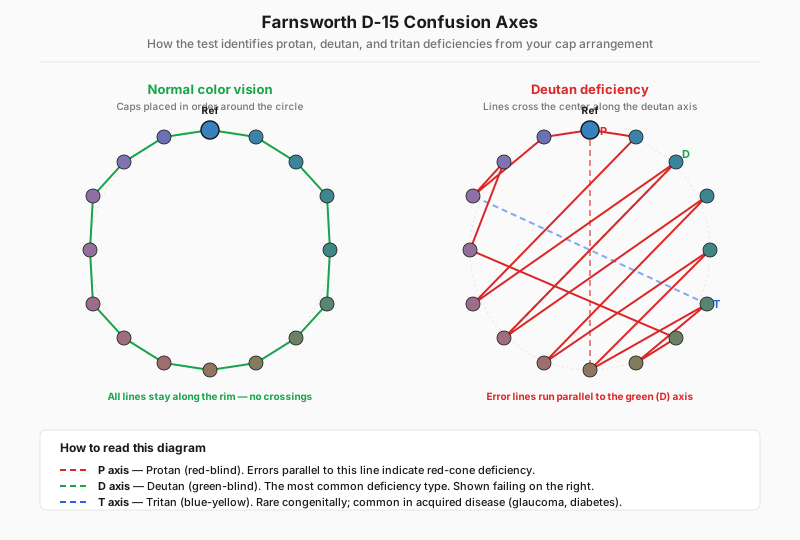
It is an arrangement test: you place the 15 caps in chromatic order starting from the reference. People with normal color vision arrange them in the natural color-wheel sequence. People with color vision deficiency confuse caps that lie on opposite sides of their specific confusion axis — and the pattern of confusions reveals whether the deficiency is protan (red-weak), deutan (green-weak), or tritan (blue-yellow).
Unlike Ishihara plates — which are extremely sensitive but only screen for red-green deficiency — the D-15 is designed to classify: it separates normal vision and mild deficiencies from moderate-to-severe ones, and identifies the deficiency axis. A 1993 study (PubMed 8489445) compared the D-15 to the 100-Hue and found that despite using only 15 caps, the D-15 provides clinically useful severity grading in a fraction of the time.
Reported sensitivity & specificity
Studies report the original D-15 has approximately 53–80% sensitivity but very high specificity (~97–100%) compared to the anomaloscope (the diagnostic gold standard). In plain terms: if you fail the D-15, you almost certainly have a real color vision deficiency. If you pass, you may still have a mild deficiency the test isn't sensitive enough to catch — which is exactly why the Lanthony desaturated D-15 was developed (more on that below).
How a clinical D-15 should be administered
If you're searching for this test for an upcoming occupational medical exam, knowing the standardized clinical conditions is genuinely useful — both so you can advocate for proper testing conditions, and so you understand why results can vary.
Lighting standards
The D-15 should be performed under CIE Illuminant C or D65 (simulating natural overcast daylight) at approximately 6000–7000K color temperature with a Color Rendering Index (CRI) of 90 or higher. Light should fall on the test surface at roughly 45° to minimize glare on the matte cap surfaces. Standard warm office LEDs (CRI 70–80) can artificially worsen red-green discrimination — which is one reason a candidate may fail in one clinic and pass in another.
Viewing distance and time
The test surface should be at a normal reading distance (~50 cm). The standard administration allows up to 2 minutes per eye, but is not a speed test — examiners encourage careful comparison rather than rushing.
What the patient is told
Examiners give a standardized script: "Starting from this fixed reference cap, find the loose cap whose color most closely matches it. Place it next. Then find the cap that most closely matches the one you just placed, and continue this until all 15 caps form a gradual color sequence. Take your time, but try to finish within about two minutes."
The screen calibration problem (and why this page asks you to check first)
The standardized clinical setup exists for a reason. On an online D-15, your screen replaces both the printed caps and the daylight booth. That's why this page shows a lighting calibration check before the test — pure RGB swatches and a grayscale ramp let you verify your display can render distinct colors and accurate luminance before you commit your result. Skip the check if you trust your setup, but don't skip thinking about it.
Understanding your score
After you submit your arrangement, this tool computes three things: a total error score (the cumulative distance of your wrong-order placements on the color circle), per-axis error counts (how many of your errors run along the protan, deutan, or tritan axis), and a diagnostic label.
Why this scoring exists: the Vingrys & King-Smith method
The total-error and axis-classification numbers shown above are not arbitrary. They are derived from the Vingrys & King-Smith scoring technique published in Investigative Ophthalmology & Visual Science in 1988 — still the most widely cited quantitative method for panel color tests. Their approach computes two key metrics from your arrangement: the Confusion Angle (CA), which is the average orientation of your error vectors on the color circle (this tells the test which axis you confuse — protan, deutan, or tritan), and the Confusion Index (CI), which is the magnitude of your total error normalized to a population-average baseline (this tells the test how severe the deficiency is). In rough clinical terms: a CA under 5° means your errors don't favor any axis (likely normal or random), a CA of 5–15° suggests a mild bias along one axis, and a CA above 15° indicates a clear directional bias consistent with a real deficiency. The total-error and protan/deutan/tritan percentages shown on this page are this exact framework, just translated into everyday numbers — most online D-15 tools skip this entirely and only give you pass/fail.
Severity thresholds
Reading the confusion axes
Toggle the "Show confusion axes" button on the result diagram. You'll see three dashed reference lines:
If your error lines run parallel to one of these axes, that strongly suggests the corresponding deficiency type. If your errors are scattered with no clear axis, see the anarchic results section below.
Anarchic results: when the axes don't tell a clean story
Sometimes a person produces a chaotic arrangement that doesn't line up with any congenital confusion axis. There are three common explanations, in roughly this order: (1) Acquired color vision defects from macular disease, optic neuritis, diabetic retinopathy, or medication toxicity — these affect color perception in unpredictable ways rather than along the inherited axes; (2) Misunderstanding the instructions — the person didn't realize they were supposed to build a smooth gradient; (3) Inconsistent attention or fatigue. If your result looks anarchic, retake the test slowly and, if it persists, that's a real reason to schedule a comprehensive eye exam — chaotic D-15 patterns are often the first sign of conditions worth catching early.
Pass/fail by profession
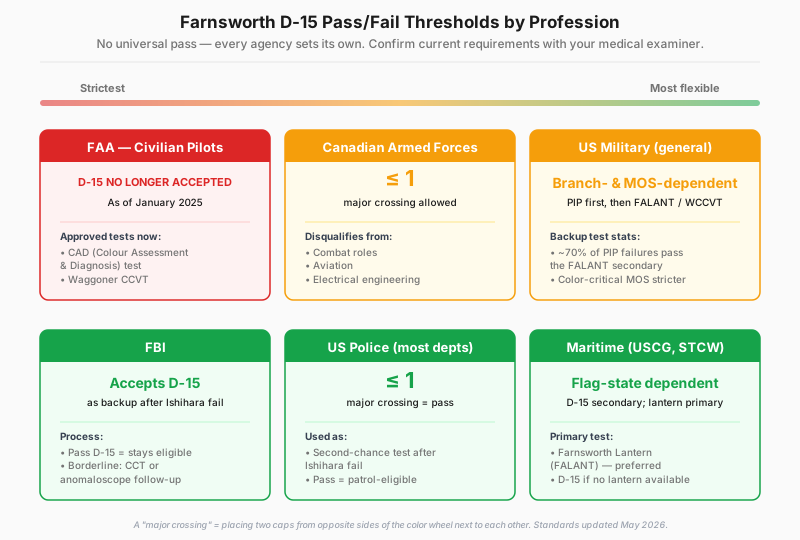
There is no universal passing threshold for the D-15 — every hiring agency and aviation regulator sets its own. Understanding what your target profession actually requires is the single most useful thing you can do before an occupational color vision exam.
| Profession / agency | How they grade D-15 | Notes |
|---|---|---|
US Police / Law Enforcement (most departments) | Pass = 0 or 1 major crossing. | The D-15 is commonly offered as a second-chance test after failing Ishihara. Pass and you're typically eligible for patrol duty. |
FBI | Accepts D-15 as a backup after Ishihara failure. | Same logic as most law enforcement — D-15 success keeps you in the candidate pool. |
US Military (varies by MOS) | Strict — typically no major crossings allowed for color-critical specialties. | Aviation, electronics, ammunition handling specialties have stricter standards than infantry. Always check the specific MOS requirement. |
Canadian Armed Forces | Pass = no errors or only adjacent swaps; max 1 major crossing. | Codified in the CAF medical category system. Two or more major crossings disqualifies from combat, aviation, and electrical engineering roles. |
FAA (civilian pilots) | No longer accepted as of January 2025. | The FAA discontinued recognition of the Farnsworth D-15 for pilot medical certification. Approved alternatives now include the CAD (Colour Assessment & Diagnosis) test and the Waggoner CCVT. Confirm current requirements with your AME. |
Maritime / Merchant marine | Varies by flag state. | Lantern tests are still common in maritime; D-15 acceptance depends on the regulatory body. IMO STCW standards reference "color vision adequate for the duties." |
Important: rules change. Before any career decision, confirm the current requirement directly with your hiring agency or aviation medical examiner. The FAA's 2025 D-15 removal is a recent example of how fast these standards move.
Farnsworth D-15 vs Lanthony Desaturated D-15
Both tests share the same administration procedure and the same 16-cap layout — the only difference is cap saturation. This tool lets you switch between them with the Saturated/Desaturated toggle on the start screen.
Farnsworth (Saturated) D-15
Uses vivid, fully-saturated colored caps. Designed to separate moderate-to-severe color vision deficiencies from normal/mild. If you pass the saturated D-15, your color vision is good enough for most occupational color-coded tasks. If you fail it, you have at least a moderate deficiency.
Lanthony (Desaturated) D-15
Uses pastel, faded versions of the same hues. The reduced saturation makes discrimination significantly harder — even mild deficiencies show up. It's primarily used clinically to detect acquired color vision loss in patients being monitored for glaucoma, diabetic retinopathy, or optic neuropathies, where catching early changes matters.
Which one should you take?
If you're checking yourself out of curiosity or for an occupational pre-screen, start with the saturated version. If you passed the saturated D-15 but suspect a mild deficiency, or your doctor is monitoring you for a retinal or optic nerve condition, try the desaturated version — it's much more sensitive to subtle changes. Note that Lanthony is not appropriate after you've already failed the saturated D-15; the result won't add new information.
How the D-15 compares to other color vision tests
Most patients don't take just one color vision test — they take a battery. Here's where the D-15 sits in the standard clinical workflow.
| Test | Primary purpose | Time | Clinical role |
|---|---|---|---|
| Ishihara plates | Red-green screening | < 1 min | First-line screener. Very sensitive but only detects red-green; no severity grading. |
| Farnsworth D-15 | Classification & severity (mild vs moderate-severe) | 2–3 min/eye | Used after Ishihara failure to classify type and rough severity. |
| Lanthony desaturated D-15 | Detecting mild & acquired defects | 3–5 min/eye | Picks up mild defects missed by the saturated D-15; monitors acquired disease. |
| Farnsworth-Munsell 100-Hue | In-depth hue discrimination | 15–20+ min | Granular severity scoring. Used in research and detailed clinical workups. |
| Nagel anomaloscope | Definitive red-green diagnosis | 10–15 min | Gold standard — required for definitive classification of protanopia vs deuteranopia. |
Think of the workflow as: Ishihara screens → D-15 classifies → 100-Hue or anomaloscope confirms. Each test has a job; none replaces the others.
Limitations of this online test (please read)
- Screen calibration matters. Even after the lighting check, no consumer screen perfectly reproduces the spectral output of standardized D65 illumination. Results from an online D-15 can differ by 10-20% from a properly administered clinical D-15.
- Sensitivity ceiling. The saturated D-15 has roughly 53–80% sensitivity — meaning even in a clinic, up to half of mild deficiencies can pass undetected. Online versions are equal or worse. If you suspect a mild deficiency, take the desaturated version and consult a professional.
- Not for official medical clearance. No online test — including this one — is acceptable for FAA, military, police, or maritime medical certification. Use this page to understand your color vision; use a clinically administered test for any record that affects your career.
- Practice does not change your color vision. A 2018 PubMed-indexed study (PubMed 29683989) specifically investigated whether subjects could be trained to pass the D-15 through practice. Results were mixed — some learned to compensate using luminance cues — but for most candidates, the test reflects underlying color vision, not learned strategy.
Sources & corrections
This page draws on publicly available material from the National Eye Institute, the American Academy of Ophthalmology, PubMed-indexed research, the FAA Aviation Medical Examiners Guide, and standard color vision reference textbooks (Birch, Diagnosis of Defective Colour Vision, 2nd ed.). It is not authored by a licensed clinician. If you spot a factual error, a citation that is out of date, or a profession-specific requirement that has changed, write to support@colorblindtests.net. Corrections are typically reviewed within 48 hours.
Frequently Asked Questions
Related tests and reading
D-15 vs Munsell 100 Hue (Comparison)
Which color vision test should you take? A practical, PubMed-backed comparison of the two arrangement tests.
How to Pass the D-15 (Practical Guide)
Honest preparation strategies, what each profession requires (police, FBI, military, FAA), and what happens if you fail.
D-15 Color Blind Test (Quick version)
The simpler-language version of this test, aimed at general users rather than clinical readers.
Farnsworth-Munsell 100 Hue Test
The 88-cap big sibling of the D-15. Slower but much more sensitive — used for severity grading.
Army Color Blind Requirements (Guide)
What US Army, Navy, Air Force, and Marines actually require for color vision — by job (MOS / rating / AFSC).
Ishihara Test
The 38-plate first-line screener for red-green color blindness.