
Types of Color Blindness: A Complete Guide to Every Form of Color Vision Deficiency
From mild red-green weakness to total color blindness — what each type looks like, who it affects, and how to test for it.
Key takeaway
Color blindness is not a single condition — it is a spectrum of at least eight distinct types, ranging from subtle green-weakness (which 5% of men have without knowing) to complete gray-scale vision (1 in 30,000). Understanding your specific type determines which color blind test to take, which optical aids might help, and which daily situations will challenge you most.
Most people think color blindness means seeing the world in black and white. In reality, total color blindness is extraordinarily rare. The vast majority of color-blind people see a full range of colors — they just confuse specific pairs that look identical to them but obviously different to everyone else.
Which pairs they confuse depends entirely on which type of color blindness they have. A person with Protanopia (red-blind) confuses different colors than someone with Tritanopia (blue-blind). The tests that detect each type are different too — the standard Ishihara test only screens for red-green deficiency, not blue-yellow.
This guide explains every clinically recognized type of color vision deficiency: what causes it at the cellular level, how common it is, what the world looks like through that lens, and which test detects it. We will start with the classification system ophthalmologists use, then work through each type in detail.
How Normal Color Vision Works
The human retina contains two types of photoreceptor cells: rods (which detect light intensity and enable night vision) and cones (which detect color). There are three types of cones, each tuned to a different range of wavelengths:
| Cone Type | Sensitive To | Peak Wavelength | Gene Location |
|---|---|---|---|
| L-cones (Long) | Red light | 564 nm | X chromosome (Xq28) |
| M-cones (Medium) | Green light | 534 nm | X chromosome (Xq28) |
| S-cones (Short) | Blue light | 420 nm | Chromosome 7 |
When all three cone types are present and functional, the brain combines their signals to distinguish approximately one million color shades. Color blindness occurs when one or more cone types are absent (dichromacy), shifted in sensitivity (anomalous trichromacy), or completely nonfunctional (monochromacy).
Notice that the L-cone and M-cone genes both sit on the X chromosome. Because males have only one X chromosome (XY), a single defective copy causes color blindness. Females (XX) need both copies to be defective — which is why red-green color blindness affects 8% of males but only 0.5% of females (National Eye Institute [1]). The S-cone gene sits on chromosome 7 — an autosome — so blue-yellow color blindness affects both sexes equally. For a deeper dive into the inheritance patterns, see our guide on the genetics of color blindness.
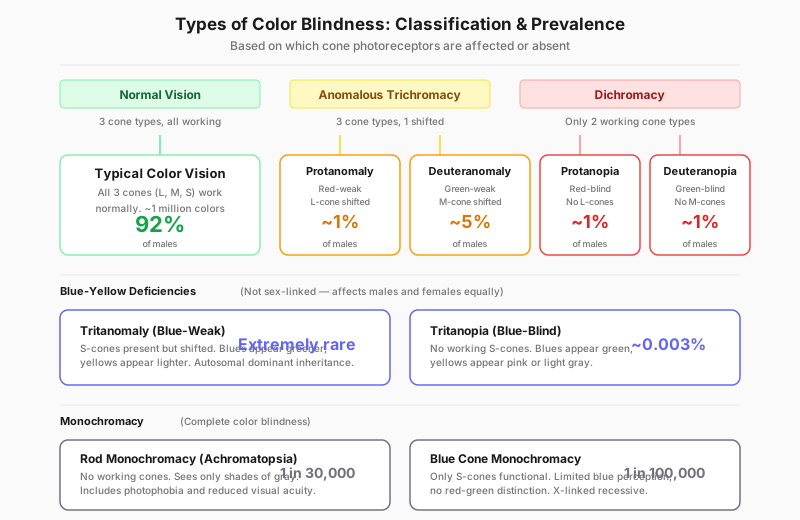
Complete classification of color vision deficiencies with prevalence data. Red-green types account for ~99% of cases.
Red-Green Color Blindness (Most Common)
Red-green color blindness encompasses four subtypes — two mild (anomalous trichromacy) and two severe (dichromacy). Together they account for roughly 99% of all inherited color blindness. All four are X-linked recessive, meaning they primarily affect males.
Deuteranomaly (Green-Weak) — The Most Common Type
The M-cones (green-sensitive) are present but their peak sensitivity is shifted toward longer (redder) wavelengths. This means greens, yellows, and reds all appear more similar than they should. Deuteranomaly is the single most common form of color blindness worldwide — about 1 in 20 men have it.
Many people with mild deuteranomaly go their entire lives without knowing. They may notice that autumn foliage looks less vivid, or that certain shades of green and orange are hard to tell apart, but the shifts are subtle enough to pass unnoticed in daily life.
Common confusions
Green vs. yellow, orange vs. light green, red vs. brown, pink vs. gray. Traffic light colors remain distinguishable for most deuteranomalous individuals, though the green light may appear more white than green.
Protanomaly (Red-Weak)
The L-cones (red-sensitive) are present but shifted toward shorter (greener) wavelengths. Reds appear duller and darker than normal, and orange, yellow, and green look more similar to each other. Unlike deuteranomaly, protanomaly causes a noticeable dimming of red colors. This is clinically important because red warning lights, brake lights, and red text on dark backgrounds may appear less conspicuous.
Common confusions
Red vs. dark gray/black, orange vs. green, red vs. brown. Reds appear dimmer than they do to people with deuteranomaly. A red traffic light may look like a dim amber.
Deuteranopia (Green-Blind)
The M-cones are completely absent. The person has only two working cone types (L and S), so they see the world through a two-dimensional color space instead of three. The entire red-orange-yellow-green range collapses into varying shades of brownish-yellow. Blues and purples appear similar to each other.
Deuteranopia is the severe form of deuteranomaly. While deuteranomaly shifts colors slightly, deuteranopia eliminates an entire axis of color discrimination. A ripe red strawberry on a green bush looks like one uniform color to a deuteranope.
Common confusions
Red vs. green (appear nearly identical), blue vs. purple, bright green vs. yellow, pink vs. light gray/white, mid-red vs. mid-brown. Take our red-green color blind test to screen for this type, or read the full deuteranopia guide →
Protanopia (Red-Blind)
The L-cones are completely absent. Like deuteranopia, the person sees through only two cone types (M and S). Red-green discrimination is lost, but with an important additional effect: reds appear very dark, almost black. This is because the L-cones are normally the primary detector of red light — without them, red wavelengths produce almost no signal.
This brightness reduction for reds distinguishes protanopia from deuteranopia clinically. A protanope sees a red traffic light as a dim, dark dot rather than a bright signal. This has safety implications for driving with color blindness, particularly at night. Read the full protanopia guide →
Common confusions
Black vs. many shades of red, dark brown vs. dark green/dark orange/dark red, some blues vs. reds/purples/dark pinks, mid-greens vs. oranges (Colour Blind Awareness [2]).
Protanopia vs. Deuteranopia — Side-by-Side Comparison
| Feature | Protanopia | Deuteranopia |
|---|---|---|
| Missing cone | L-cones (red) | M-cones (green) |
| Red appears | Very dark, almost black | Brownish-yellow, normal brightness |
| Green appears | Tan/brownish | Tan/brownish |
| Brightness of reds | Significantly dimmed | Normal brightness |
| Neutral point | ~492 nm (blue-green) | ~498 nm (blue-green) |
| Driving risk | Higher (red lights appear dim) | Moderate (rely on position) |
| Prevalence (males) | ~1.0% | ~1.2% |
Blue-Yellow Color Blindness (Rare)
Blue-yellow color blindness affects the S-cones (blue-sensitive). Because the S-cone gene sits on chromosome 7 (an autosome, not a sex chromosome), blue-yellow deficiency is not sex-linked — it affects males and females equally. It is also much rarer than red-green types.
Tritanomaly (Blue-Weak)
The S-cones are present but their spectral sensitivity is shifted. Blues appear greener, and yellows appear lighter or pinkish. Tritanomaly is inherited as an autosomal dominant trait, meaning only one copy of the defective gene is needed — a different inheritance pattern from all other color vision deficiencies, which are recessive.
Tritanopia (Blue-Blind)
The S-cones are completely absent. The person sees through only L and M cones, losing discrimination along the blue-yellow axis. Blues and greens become confused, yellows may appear pinkish or light gray, and the sky may look greenish. Purple is often indistinguishable from a dark reddish-brown.
Tritanopia is more often acquired (from disease, medication, or aging) than inherited. Conditions that can cause acquired tritanopia include diabetic retinopathy, glaucoma, age-related macular degeneration, and exposure to certain industrial solvents (Cleveland Clinic [3]). Screen for this type with our blue-yellow color blind test, or read the full tritanopia guide →.
Common confusions (blue-yellow types)
Light blue vs. gray, dark purple vs. black, mid-green vs. blue, orange vs. red, yellow vs. pink. Notably, red-green discrimination remains normal — the standard Ishihara test will show no errors for a tritanope.
Complete Color Blindness (Monochromacy)
Monochromacy is the only form where the term "color blind" is literally accurate — these individuals see no color at all, or only a trace of blue. Both forms are extremely rare and carry additional visual symptoms beyond color perception.
Rod Monochromacy (Achromatopsia)
All three cone types are nonfunctional. Vision relies entirely on rod cells, which detect only light intensity — not wavelength. The result is true grayscale vision. But the consequences go far beyond color:
- Photophobia — Extreme sensitivity to bright light. Rods saturate in normal daylight, causing pain and whiteout. Most achromats wear dark tinted or red-filtered glasses indoors.
- Nystagmus — Involuntary rapid eye movements, often present from birth.
- Reduced visual acuity — Typically 20/200 or worse (legally blind in many jurisdictions), because the fovea (center of sharpest vision) contains almost exclusively cones, and without functional cones the fovea is essentially blind.
- Hemeralopia — Better vision in dim light than bright light (the reverse of normal).
Important note on misdiagnosis
Some optometrists using only the Ishihara test may report "total color blindness" when a patient fails all plates. The Ishihara test cannot detect blue-yellow vision or true achromatopsia — it only screens for red-green deficiency. A person who fails all Ishihara plates almost certainly has severe red-green dichromacy, not achromatopsia. True achromatopsia requires clinical testing with an anomaloscope or ERG (electroretinogram) for confirmation.
Blue Cone Monochromacy
Only the S-cones (blue-sensitive) function. Both L-cones and M-cones are absent or nonfunctional. The person retains a limited sense of blue but cannot distinguish reds, greens, yellows, or oranges. Like achromatopsia, blue cone monochromacy causes reduced visual acuity and some light sensitivity — though typically less severe than rod monochromacy. Because it is X-linked, it almost exclusively affects males.
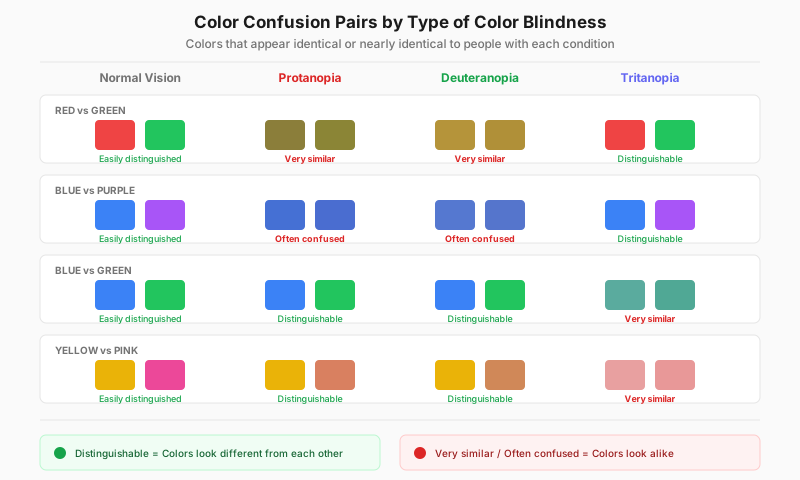
How common color pairs appear across different types. Red-green types confuse the top rows; blue-yellow types confuse the bottom rows.
Acquired vs. Inherited Color Blindness
Not all color blindness is genetic. Acquired color vision deficiency can develop at any age due to disease, medication, or environmental exposure. Key differences:
| Feature | Inherited | Acquired |
|---|---|---|
| Onset | Present from birth | Develops later in life |
| Progression | Stable — severity never changes | Can worsen or improve over time |
| Affects | Both eyes equally | May affect one eye more than the other |
| Most common type | Red-green (protan/deutan) | Blue-yellow (tritan) in early stages |
| Reversible? | No | Sometimes, if underlying cause is treated |
| Common causes | Genetic mutation on X chromosome or chromosome 7 | Diabetes, glaucoma, MS, medications (Ethambutol, Digoxin), aging |
Acquired blue-yellow deficiency is particularly common in adults over 65. As the lens yellows with age, it absorbs more short-wavelength (blue) light, producing a gradual tritanomaly-like shift. An estimated 3% of the population over 65 have clinically measurable acquired color vision deficiency (Colour Blind Awareness [4]).
Prevalence: How Common Is Each Type?
The following table consolidates prevalence data from population studies. Rates vary by ethnicity — these figures represent global averages. Northern European populations tend to have slightly higher rates; sub-Saharan African and Indigenous Australian populations tend to have lower rates (Birch, 2012 [5]).
| Type | Category | Males | Females | Severity |
|---|---|---|---|---|
| Deuteranomaly | Red-green | 5.0% | 0.35% | Mild–Moderate |
| Protanomaly | Red-green | 1.0% | 0.03% | Mild–Moderate |
| Deuteranopia | Red-green | 1.2% | 0.01% | Severe |
| Protanopia | Red-green | 1.0% | 0.01% | Severe |
| Tritanomaly | Blue-yellow | Extremely rare (equal in both sexes) | Mild | |
| Tritanopia | Blue-yellow | ~0.003% (equal in both sexes) | Severe | |
| Achromatopsia | Monochromacy | ~0.003% (1 in 30,000) | Complete | |
| Blue cone mono. | Monochromacy | ~0.001% (1 in 100,000) | Complete | |
Which Color Blind Test Detects Which Type?
Not all color blind tests are equal. Each test targets different types and provides different levels of diagnostic detail:
| Test | Red-Green | Blue-Yellow | Protan vs Deutan | Severity |
|---|---|---|---|---|
| Ishihara Test | Yes | No | Limited | Rough |
| Red-Green Test | Yes | No | Moderate | Moderate |
| Blue-Yellow Test | No | Yes | N/A | Moderate |
| FM100 Hue Test | Yes | Yes | Yes | Detailed |
| Anomaloscope (clinical) | Yes | Yes | Yes | Gold standard |
If you suspect you have color blindness but are not sure which type, start with our free Ishihara color blind test for a quick red-green screening. For a more comprehensive assessment that covers all axes, the Farnsworth-Munsell 100 Hue test identifies the specific type and severity. If you want a faster arrangement test that still classifies the deficiency axis, try the Farnsworth D-15 test. For a definitive clinical diagnosis, ask your ophthalmologist for an anomaloscope examination.
The Bottom Line
Color blindness is not one condition — it is a family of at least eight distinct types, each caused by a different photoreceptor problem, producing different color confusions, and requiring different tests to detect. The overwhelming majority of color blind people (about 95%) have some form of red-green deficiency, and most of those have the mild green-weak form (deuteranomaly) that they may never even notice.
Knowing your specific type matters for practical reasons: it determines which color blind test will actually detect your condition, whether color-correcting glasses (EnChroma, Pilestone) are likely to help, and which daily situations need the most adaptation. If you suspect any form of color vision deficiency, taking an online screening test is a free, immediate first step — followed by a professional evaluation for a precise diagnosis.
Want to understand how color blindness is passed from parents to children? Read our guide on the genetics of color blindness. Concerned about a child? See early signs of color blindness in children. Wondering about career implications? Check jobs for colorblind people. And if your main question is whether your type can be treated, read can color blindness be cured? or get quick answers to 50+ common questions in our color blindness FAQ.
Sources
- National Eye Institute. "Color Blindness." nei.nih.gov
- Colour Blind Awareness. "Types of Colour Blindness." colourblindawareness.org
- Cleveland Clinic. "Color Blindness." clevelandclinic.org
- Colour Blind Awareness. "Acquired Colour Vision Defects." colourblindawareness.org
- Birch, J. (2012). "Worldwide prevalence of red-green color deficiency." Journal of the Optical Society of America A, 29(3), 313–320. PubMed
- American Academy of Ophthalmology. "What Is Color Blindness?" aao.org
Frequently Asked Questions
Related Articles
- Tetrachromacy Test: Can You Really See 100 Million Colors?
- Why People See “The Dress” Differently
- The Genetics of Color Blindness: Why Men Are More Affected
- Is My Child Color Blind? What to Watch for at Every Age
- Can You Drive If You Are Color Blind? Country-by-Country Rules
- Best Jobs for Colorblind People (and Careers to Avoid)