
The Genetics of Color Blindness: Why 1 in 12 Men Are Affected
Almost every colorblind person you have ever met is probably male. This is not a coincidence — it is a direct consequence of how human chromosomes are arranged.
Globally, approximately 8% of males (1 in 12) and only 0.5% of females (1 in 200) have some form of color vision deficiency (CVD), according to the National Eye Institute. That 16:1 male-to-female ratio is one of the most striking sex differences in all of human biology — and it comes down to a single chromosome.
This article explains the science from the ground up: how your retina detects color, which genes control the process, why men are so much more vulnerable, and what the inheritance odds are for your children.
How Your Eyes Detect Color: Cones and Opsins
Color perception starts in the retina — a thin layer of light-sensitive tissue at the back of each eye. The retina contains two types of photoreceptor cells:
- Rods — About 120 million per eye. They handle low-light (scotopic) vision and detect motion, but they cannot distinguish colors.
- Cones — About 6-7 million per eye. They operate in bright light and are responsible for all color perception. There are three subtypes.
The Three Cone Types
Each cone contains a light-sensitive protein called an opsin. The opsin determines which wavelengths of light that cone responds to most strongly. According to MedlinePlus Genetics, the three types are:
- L cones (Long-wavelength) — Peak sensitivity around 564 nm (yellow-orange light). Encoded by the OPN1LW gene. These give you your perception of red.
- M cones (Medium-wavelength) — Peak sensitivity around 534 nm (yellow-green light). Encoded by the OPN1MW gene. These give you your perception of green.
- S cones (Short-wavelength) — Peak sensitivity around 420 nm (blue-violet light). Encoded by the OPN1SW gene on chromosome 7.
Your brain combines the signals from all three cone types to produce the full spectrum of color you perceive. When one type is missing or defective, specific colors become indistinguishable — and that is color blindness.
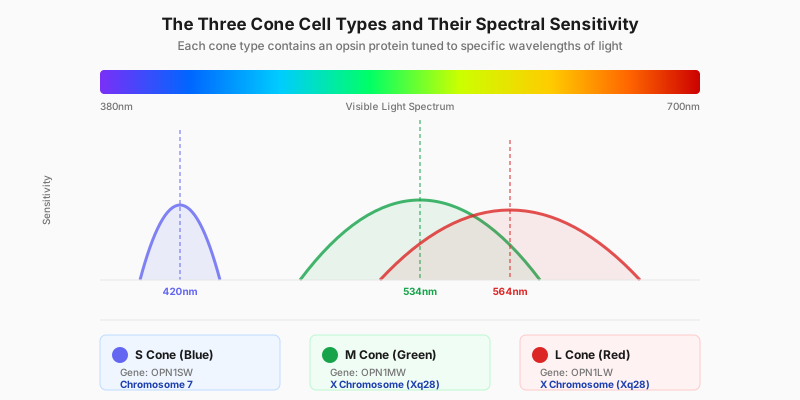
The three cone cell types and their sensitivity across the visible spectrum. L and M cone genes sit on the X chromosome; the S cone gene is on chromosome 7.
Why the X Chromosome Makes Men Vulnerable
Here is the critical fact: the genes for L cones (OPN1LW) and M cones (OPN1MW) are both located on the X chromosome at position Xq28. The two genes share over 98% of their DNA sequence, indicating they arose from a gene duplication event roughly 30-40 million years ago. This high similarity makes them prone to errors during DNA replication — the genetic mechanism behind most color vision deficiency.
Now consider the difference between male and female chromosomes:
- Males (XY) — Carry only one X chromosome. If that single X has a defective OPN1LW or OPN1MW gene, there is no backup copy. The cone will be absent or malfunction, and the male will be colorblind.
- Females (XX) — Carry two X chromosomes. Even if one X has a defective gene, the corresponding gene on the other X typically compensates. The female has normal color vision but becomes a carrier.
For a female to be colorblind, she must inherit a defective gene from both parents — meaning her father must be colorblind and her mother must be at least a carrier. This double requirement is why female color blindness is so rare (0.5% vs 8%).
What About Blue-Yellow Color Blindness?
Tritanopia (blue-yellow color blindness) follows a completely different pattern. The S cone gene (OPN1SW) sits on chromosome 7 — an autosome, not a sex chromosome. It is inherited in an autosomal dominant pattern, meaning only one copy of the mutated gene is enough to cause the condition regardless of sex. Males and females are affected equally, but tritanopia is extremely rare — fewer than 1 in 10,000 people worldwide.
The Types of Red-Green Color Blindness
Red-green CVD is not a single condition. It encompasses four distinct subtypes based on which cone is affected and how severely:
- Deuteranomaly (~5% of males) — The M cone opsin is shifted toward longer wavelengths, making greens appear more reddish. This is the most common form and is usually mild. Most people with deuteranomaly are unaware they have it until tested.
- Protanomaly (~1.3% of males) — The L cone opsin is shifted toward shorter wavelengths, making reds appear darker and more greenish. Affected individuals often notice that red objects look dimmer than others expect.
- Deuteranopia (~1.2% of males) — Complete absence of functional M cones. Greens and reds are genuinely indistinguishable. This is a more severe form diagnosed by tests like the Farnsworth-Munsell 100 Hue test.
- Protanopia (~1% of males) — Complete absence of functional L cones. Similar to deuteranopia in practical impact, but with additional dimming of the red end of the spectrum.
These subtypes are important because they respond differently to interventions. Anomalous trichromacy (deuteranomaly/protanomaly) responds well to notch-filter lenses because the cones still exist — they are just shifted. Dichromacy (deuteranopia/protanopia) does not respond because the cone type is entirely absent.

X-linked inheritance patterns for red-green color blindness. The defective gene (shown in red) must be on the X chromosome for a male to be affected, but on both X chromosomes for a female.
Inheritance Odds: Will My Child Be Colorblind?
The inheritance probabilities for red-green color blindness are predictable because the trait follows classic Mendelian X-linked recessive genetics. Based on data from the Colour Blind Awareness organisation and StatPearls (NCBI), here are the four most common scenarios:
Scenario 1: Colorblind Father + Normal Mother
- Sons: 0% chance of color blindness (they receive Y from dad, normal X from mom)
- Daughters: 100% will be carriers (they receive the affected X from dad, normal X from mom)
Key insight: a colorblind father cannot pass the trait directly to his sons, because fathers give sons their Y chromosome.
Scenario 2: Normal Father + Carrier Mother
- Sons: 50% chance of being colorblind (if they inherit mom's affected X)
- Daughters: 50% chance of being carriers (normal vision but carrying the gene)
This is the most common real-world scenario and explains why color blindness "skips a generation" — from grandfather to grandson through an unaffected carrier mother.
Scenario 3: Colorblind Father + Carrier Mother
- Sons: 50% chance of being colorblind
- Daughters: 50% chance of being colorblind (both X chromosomes affected), 50% chance of being carriers
This is the only common scenario that produces colorblind females.
Scenario 4: Both Parents Colorblind
- All children: 100% will be colorblind (both boys and girls receive a defective X from each parent)
This scenario is extremely rare because it requires the mother to be colorblind (0.5% of females).
Why Color Blindness "Skips" a Generation
One of the most commonly observed patterns in families is color blindness appearing to skip a generation. A grandfather is colorblind, his children all have normal vision, but then his grandson is colorblind. The mechanism is straightforward:
- The colorblind grandfather passes his affected X to all daughters (Scenario 1)
- Those daughters become carriers with normal vision
- When a carrier daughter has sons, each son has a 50% chance of receiving her affected X (Scenario 2)
The gene did not "skip" — it was present in the carrier mother the entire time. She simply had a functional backup copy on her other X chromosome that masked the deficiency. This pattern is characteristic of all X-linked recessive traits, including hemophilia and Duchenne muscular dystrophy.
Not All Color Blindness Is Genetic
While the vast majority of color vision deficiency is inherited, MedlinePlus notes that acquired forms also exist. These can develop later in life due to:
- Retinal diseases — Age-related macular degeneration, diabetic retinopathy, or glaucoma can damage cone cells
- Optic nerve damage — Multiple sclerosis or optic neuritis can disrupt color signals between the eye and brain
- Medications — Chloroquine (antimalarial), ethambutol (tuberculosis), and some antiseizure drugs can cause temporary or permanent color vision changes
- Chemical exposure — Organic solvents and certain industrial chemicals can damage the retina
- Aging — Gradual yellowing of the lens after age 60 can subtly shift color perception, particularly in the blue-yellow axis
The key difference: acquired CVD can sometimes be treated by addressing the underlying cause, while inherited CVD is permanent. If you notice a sudden change in your color perception, see an ophthalmologist — it may indicate a treatable condition.
The Future: Gene Therapy Research
In 2009, researchers at the University of Washington successfully restored color vision in adult squirrel monkeys using gene therapy — inserting a functional L cone gene into animals that had been missing it since birth. The study, published in Nature, demonstrated that the primate brain can learn to interpret new color signals even in adulthood.
As of 2026, no gene therapy for human color blindness has received FDA approval. However, several clinical trials are underway for related retinal conditions (including achromatopsia and blue cone monochromacy), and the underlying technology — adeno-associated virus (AAV) vectors delivering functional opsin genes directly to cone cells — is advancing rapidly. For the full picture of what can and can't be treated across every type, see our guide on whether color blindness can be cured.
In the meantime, individuals with anomalous trichromacy can benefit from optical aids like EnChroma glasses, which enhance the separation between shifted cone responses. To determine what type and severity of CVD you have, start with our Ishihara screening test.
How to Find Out If You Are a Carrier
Women who suspect they may be carriers (for example, if their father is colorblind or they have a colorblind son) can gain insight through:
- Color discrimination tests — Some carriers show subtly reduced color discrimination on sensitive tests like the Farnsworth-Munsell 100 Hue test, even though they pass the Ishihara test normally
- Family history — If your father is colorblind, you are definitively a carrier (100% — he gave you his only X)
- Genetic testing — Clinical labs can sequence the OPN1LW and OPN1MW genes to identify specific mutations
Understanding carrier status is valuable for family planning, as it determines the odds that future sons may inherit color vision deficiency. For parents wondering about their children, our early signs of color blindness in children guide covers behavioral cues to watch for in toddlers.
Frequently Asked Questions
Sources
- National Eye Institute (NIH) — Color blindness prevalence and clinical overview
- MedlinePlus Genetics — Comprehensive genetics reference for color vision deficiency including OPN1LW, OPN1MW, OPN1SW gene details
- StatPearls — Genetics, X-Linked Inheritance (NCBI Bookshelf) — Medical reference on X-linked recessive inheritance patterns
- Neitz & Neitz (2011) — "The genetics of normal and defective color vision" — Peer-reviewed paper in Vision Research covering opsin gene structure and spectral tuning
- Colour Blind Awareness — Inheritance patterns and family planning guidance for carriers
- Mancuso et al. (2009) — Gene therapy in squirrel monkeys — Nature study demonstrating successful color vision restoration via AAV-delivered opsin genes
Curious About Your Own Color Vision?
Whether you suspect you are colorblind or want to check if you might be a carrier, start with a quick screening. It takes less than 2 minutes.