
Is My Child Color Blind? What to Watch for at Every Age
A developmental timeline for parents — from first crayons to classroom challenges.
Your three-year-old paints every sun purple. Your five-year-old wears mismatched socks daily. Your seven-year-old dreads the worksheet where they have to sort objects by color. Are these normal childhood quirks — or signs of something else?
Color Vision Deficiency (CVD) affects roughly 8% of boys and 0.5% of girls worldwide — about one boy in every classroom of twenty-five. Because the condition is inherited (passed through the X chromosome from carrier mothers), children are born with it. But they often go undiagnosed until age 5 or older, simply because young children cannot articulate that their perception differs from others.
This guide organizes the warning signs by developmental stage, because what a toddler reveals through behavior is very different from what a school-age child reveals through academic struggle. Understanding the timeline helps you know when to observe, when to take a color blind test, and when to request school accommodations.
Ages 2–3: The First Subtle Clues
At this age, children are still learning color names. It is perfectly normal for a two-year-old to call red "orange" or mix up blue and green — their vocabulary is developing. However, certain patterns stand out even before formal color naming is established.
What to observe
- 1.Sorting games break down by color. Give your child a mixed pile of red and green LEGO bricks and ask them to sort by color. A child with typical vision does this easily by age 2.5. A child with red-green CVD will sort randomly or by size instead. Repeat with blue and purple objects to check for tritan-type confusion.
- 2.The "wrong fruit" identification. Show your child a red apple and a green apple side by side. If they cannot tell them apart (or insist they are both the same color), this is significant. Most toddlers notice the difference even before they know the word "red."
- 3.Unusual crayon preferences. Does your child consistently avoid specific crayons, or always pick up the "wrong" one when you name a color? They may be picking by position in the box or brightness rather than hue.
Important context
At this age, a formal diagnosis is difficult. Even ophthalmologists typically wait until age 4 to administer standardized tests. Your job at this stage is simply to notice patterns — not to panic. Most pediatric eye specialists recommend a baseline eye exam by age 3 regardless of color concerns (American Academy of Ophthalmology [1]).
Ages 4–5: When Classroom Activities Reveal More
Preschool introduces structured color activities — worksheets, color-by-number, traffic light games, matching exercises. This is when CVD typically becomes noticeable to teachers and parents alike.
Red-flag scenarios
- 1.Color-by-number failures that are not random. Look at which colors are confused. Red-green CVD (by far the most common) produces specific confusion pairs: red/green, red/brown, green/brown, orange/green, and purple/blue. If your child consistently swaps these pairs while getting blue, white, and yellow correct, the pattern is diagnostic.
- 2.The "learning colors" delay that is not actually a delay. Teachers sometimes flag a child as developmentally behind because they "still cannot identify colors by age 4." In reality, the child identifies brightness, saturation, and shape perfectly — they just cannot distinguish specific hues. This is CVD, not a learning disability (GoodRx Health [2]).
- 3.LED and screen confusion. Does your child ask whether the tablet is charging (orange light) or done (green light)? Can they follow the color-changing instructions in educational apps? These small struggles often go unnoticed by parents but frustrate the child daily.
What testing is possible now
From age 4, several reliable color blind test options exist for children. The Color Vision Testing Made Easy (CVTME) color blind test uses shapes (circles, stars, squares) instead of numbers, making it suitable for pre-literate children. The Hardy-Rand-Rittler (HRR) plates use geometric symbols and can distinguish between protan, deutan, and tritan defects. By age 5, most children can also complete a standard Ishihara color blind test if they are comfortable reading numbers. Our free online color blind test is a convenient starting point before booking a clinical appointment.
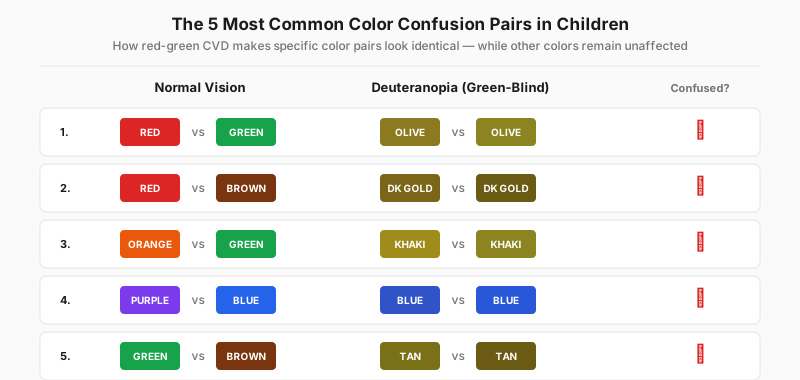
The five most common color confusion pairs in red-green CVD. Children mix these specific pairs while identifying other colors correctly.
Ages 6–8: Academic and Social Impact
By first grade, expectations shift. Children are required to use color-coded information independently: reading colored graphs, following highlighted instructions, using colored markers on whiteboards, and interpreting maps. This is when undiagnosed CVD becomes a genuine academic barrier.
Academic signs
- 1.Science and geography worksheets. Color-coded maps, pie charts, and biology diagrams rely heavily on distinguishing green from red or orange from brown. If your child consistently misreads these while performing well on text-based questions, CVD is a likely explanation.
- 2.Sport confusion. Team sports with red vs. green bibs or jerseys become genuinely confusing. Your child might pass the ball to the wrong team, not because they are inattentive, but because both teams look the same color to them.
- 3.Self-consciousness emerges. By age 7, children become acutely aware that their color answers differ from classmates. Without understanding why, they may stop volunteering answers, avoid art class, or claim they "don't like drawing." A 2019 study in the Journal of AAPOS found that children with undiagnosed CVD reported significantly lower self-confidence in classroom activities compared to diagnosed peers who had accommodations in place [3].
Social and emotional signs
Color blindness is not a disability in the medical sense, but undiagnosed CVD in a school environment can produce disability-like outcomes. Children may develop avoidance behaviors, anxiety around color-dependent tasks, or a false belief that they are "bad at school." The gap between ability and perceived performance creates confusion for both child and parent.
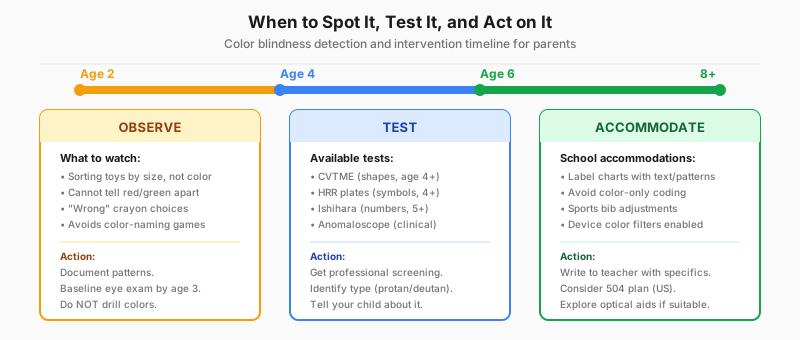
Detection and intervention timeline. Earlier awareness leads to better accommodation outcomes.
Three Things Parents Commonly Get Wrong
Mistake 1: "My child sees in black and white." Total color blindness (achromatopsia) is extremely rare — about 1 in 30,000 people. The vast majority of color-blind children have red-green CVD and see a full spectrum of colors. Their world is not gray; it simply has fewer distinguishable hues. They see yellows, blues, and whites perfectly. Learn more about the genetics behind color vision to understand why.
Mistake 2: "Let's drill the colors until they learn." Color blindness is a physical difference in the cone cells of the retina — not a knowledge gap. Drilling color names into a color-blind child is like drilling music appreciation into someone who is tone-deaf: it produces frustration, not improvement. The cones are either absent or shifted; no amount of repetition changes the photoreceptor response.
Mistake 3: "Girls cannot be color blind." Girls can be color blind — they just need to inherit the defective gene from both parents (two affected X chromosomes). This occurs in about 0.5% of females. If the father is color blind and the mother is a carrier, each daughter has a 50% chance of having CVD. Do not dismiss color confusion in girls because of the statistical rarity.
The At-Home Color Vision Checklist (by Age)
Before you book an appointment, spend a week quietly observing. This checklist turns the signs above into concrete things to watch for. Note which specific color pairs cause trouble — that detail is the most useful thing you can bring to an eye doctor. The more boxes you check, the stronger the case for a clinical color blind test.
Ages 2–4 (observation only)
- ☐ Sorts mixed red/green objects by size or randomly, not by color
- ☐ Cannot tell a red apple from a green apple side by side
- ☐ Picks the "wrong" crayon when you name a color
- ☐ Calls grass, leaves, or a green car "brown" or "red"
- ☐ Family history: a maternal grandfather or uncle is color blind
Ages 5–8 (observation + screening)
- ☐ Confuses the same pairs repeatedly: red/green, red/brown, green/brown, orange/green, purple/blue
- ☐ Gets blue, yellow, white, and black correct, but misses the pairs above
- ☐ Struggles with color-coded maps, graphs, or color-by-number sheets
- ☐ Misreads charging/status lights (orange vs. green) on devices
- ☐ Avoids art, drawing, or color-matching games, or seems embarrassed by them
- ☐ Cannot read one or more plates on a screening Ishihara test
Save or print this page to bring your notes to the appointment. Checking two or more boxes in the relevant age band is a good reason to screen at home and then see an eye care professional.
What to Do If You Suspect CVD
Step 1: Screen at home
For children age 5 and up who can identify numbers, a free online color blind test gives a useful initial indication within minutes. The Ishihara color blind test shows dot-pattern plates with hidden numbers — children who cannot read certain plates likely have red-green CVD. For younger children, try the sorting and matching observations described above and document the specific color pairs that cause confusion.
Step 2: Get a professional evaluation
A pediatric ophthalmologist or optometrist can administer clinical-grade color blind tests — the Farnsworth-Munsell 100 Hue test or anomaloscope — to determine the exact type (protan vs. deutan vs. tritan) and severity (mild anomaly vs. complete dichromacy). This distinction matters because it determines which accommodations are most helpful and whether optical aids (such as EnChroma-type notch-filter lenses) could benefit your child.
Step 3: Inform the school
Once diagnosed, communicate with your child's teacher in writing. Specific accommodations to request:
- Use text labels or patterns (not color alone) on charts, graphs, and worksheets
- Seat the child where whiteboard glare is minimized (color contrast drops under glare)
- Avoid red-pen-on-green-paper or similar low-contrast combinations for corrections
- In sports, assign bibs with both color AND pattern/number distinction
- Allow extra time on color-dependent worksheets or provide alternative versions
In the United States, children with documented CVD may qualify for a Section 504 accommodation plan if the condition substantially limits a major life activity (learning). While not all schools grant this, having the diagnosis documented creates a record that supports the child throughout their education (US Department of Education [4]). Outside the US, similar protections exist: the UK's Equality Act 2010 requires schools to make "reasonable adjustments," Australia applies the Disability Standards for Education 2005, and Canadian provinces provide accommodations through Individual Education Plans (IEPs).
Copy-and-paste email template for your child's teacher
Most teachers want to help but have never been trained on color vision deficiency. A short, specific email works far better than a hallway conversation. Copy the template below and fill in the brackets:
Feel free to adapt this. The goal is to frame CVD as a perception difference that needs minor accommodation — not a learning problem.
Who Is Most at Risk?
CVD prevalence is not uniform across populations. Studies show significantly different rates by ethnicity and geography:
- Northern European descent: ~8% of males (highest documented rate)
- East Asian descent: ~5% of males
- African descent: ~4% of males
- Indigenous Australian: ~2% of males (lowest documented rate)
If the child's maternal grandfather or maternal uncle is color blind, the child (if male) has a 50% chance of inheriting the condition. This family-history check is the single strongest predictor and costs nothing — just a conversation at the dinner table (Colour Blind Awareness [5]).
Color Blindness and Screen-Based Learning
Modern classrooms increasingly use tablets, interactive whiteboards, and educational apps. Many of these tools rely on color for feedback (green checkmarks for correct, red X for wrong) or color-coded categories. A child with CVD may:
- Not notice whether their answer was marked correct or incorrect
- Struggle with color-matching games common in early math and reading apps
- Have difficulty with coding platforms (like Scratch) that use colored blocks to represent different functions
Most operating systems now offer built-in color filters. On iPads (common in schools), go to Settings → Accessibility → Display & Text Size → Color Filters. Android devices have similar options under Accessibility → Color correction. These adjustments shift the palette to use colors the child can distinguish. To figure out which filter to apply, take a red-green color blind test together with your child — the results will indicate whether they have a protan or deutan deficiency, which determines the correct filter setting.
The Bottom Line
Color blindness is not a disease. It does not worsen over time, it does not cause pain, and it does not limit intelligence. Famous color-blind individuals include Mark Zuckerberg (who chose Facebook's blue theme because blue is the color he sees most richly), filmmaker Christopher Nolan, and Prince William.
What it does require is awareness. A child who understands their own color vision — and has parents and teachers who accommodate it — performs just as well as their peers. The gap is not in ability; it is in the environment failing to account for a common human variation.
If you have spotted patterns in your child, do not wait. A simple color blind test gives you clarity in minutes, and early communication with school prevents years of unnecessary frustration. To understand how CVD is inherited and whether your future children might be affected, read our guide on the genetics of color blindness. For career planning down the road, see jobs and careers for colorblind people.
Sources
- American Academy of Ophthalmology. "Eye Screening for Children." aao.org
- GoodRx Health. "What Are the First Signs of Color Blindness in Children?" goodrx.com
- Journal of AAPOS (2019). "Impact of Color Vision Deficiency on Classroom Performance and Self-Confidence in Children." jaapos.org
- US Department of Education. "Protecting Students with Disabilities — Section 504." ed.gov
- Colour Blind Awareness. "Inherited Colour Vision Deficiency." colourblindawareness.org
- Birch, J. (2012). "Worldwide prevalence of red-green color deficiency." Journal of the Optical Society of America A, 29(3), 313-320. PubMed
- UK Government. "Equality Act 2010: guidance — reasonable adjustments for disabled pupils." gov.uk