
Cambridge Color Test
A computerized color vision test using Landolt C rings embedded in pseudoisochromatic dot patterns. Identify the gap direction to screen for red-green and blue-yellow color blindness.
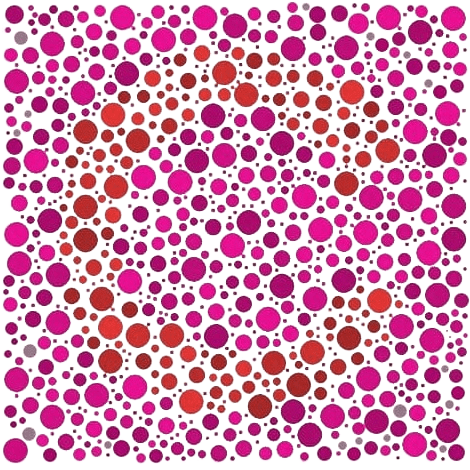
Cambridge Color Test
Identify the direction of the gap in the Landolt C ring hidden among colored dots. This test screens for both red-green and blue-yellow color vision deficiencies.
- •Look at each plate and find the C-shaped gap
- •Select the direction the gap is facing: Top, Bottom, Left, or Right
- •If you cannot see the gap, click "I Can't See"
What is the Cambridge Color Test?
The Cambridge Colour Test (CCT) is a computerized color vision assessment developed at the University of Cambridge by J.D. Mollon, J.P. Reffin, and colleagues. It was designed as a modern alternative to traditional printed plate tests like the Ishihara, offering more precise and quantifiable measurements of color discrimination thresholds.
The test displays a Landolt C (a ring with a gap) embedded in a field of pseudoisochromatic colored dots. The target ring differs in chromaticity from the background dots, and the subject must identify the direction of the gap — up, down, left, or right. This forced-choice method eliminates the subjectivity of number-reading tests.
Because the stimulus is generated on a calibrated computer display rather than printed on paper, the CCT can precisely control chromaticity coordinates and adapt difficulty in real time using a staircase procedure. It tests along protan, deutan, and tritan confusion lines, making it capable of detecting all three major types of color vision deficiency.
How to Take the Test
1. Find the Gap
Look at the plate and locate the Landolt C ring — a circle with a gap — hidden among the colored dots. The ring and the background differ in color.
2. Choose Direction
Select which direction the gap is facing using the four arrow buttons: Top, Bottom, Left, or Right. If you cannot see the ring, press "I Can't See."
3. Get Your Results
After 12 plates, you'll receive an instant assessment of your color vision with a breakdown of each response.
Clinical CCT vs. This Online Version
The clinical Cambridge Colour Test uses a calibrated CRT monitor with precise chromaticity control (CIE 1976 u'v' coordinates) and an adaptive staircase algorithm to measure exact color discrimination thresholds. Our online version adapts the core methodology with the following differences:
Clinical CCT
- - Calibrated CRT/LCD display
- - Precise CIE chromaticity control
- - Adaptive staircase procedure
- - Measures exact thresholds (u'v' units)
- - Tests protan, deutan, and tritan axes
This Online Version
- - Uncalibrated screen
- - Fixed-difficulty plates
- - Pass/fail per plate (no staircase)
- - Provides a screening score
- - Results vary with screen calibration
Note: This online test is a screening tool only and cannot replace a clinical CCT examination. If you need a precise color discrimination threshold for research or diagnosis, consult an optometrist with calibrated testing equipment.
How the Cambridge Colour Test Works
The clinical CCT operates by presenting a Landolt C ring whose chromaticity differs from the background along specific confusion lines in CIE 1976 u'v' color space. These confusion lines correspond to the three types of cone photoreceptors:
- Protan line — targets L-cone (long-wavelength) deficiency, detecting protanopia and protanomaly
- Deutan line — targets M-cone (medium-wavelength) deficiency, detecting deuteranopia and deuteranomaly
- Tritan line — targets S-cone (short-wavelength) deficiency, detecting tritanopia and tritanomaly
The test uses a four-alternative forced-choice (4AFC) paradigm — the subject must choose one of four gap directions. An adaptive staircase algorithm adjusts the chromaticity difference between the ring and background after each response, converging on the subject's discrimination threshold. This threshold, measured in u'v' units, provides a quantitative measure of color vision performance.
All dots in the display (both ring and background) vary randomly in size, and luminance is randomized to prevent the subject from using brightness cues rather than color differences. This pseudoisochromatic design ensures the test truly measures chromatic discrimination.
Understanding Your Score
11-12 Correct — Normal Vision
You can reliably distinguish the Landolt C ring from the background on all or nearly all plates. This suggests normal color discrimination.
9-10 Correct — Mild Deficiency
You may have difficulty with some chromaticity differences. This could indicate a mild color vision deficiency. Consider following up with a clinical test.
6-8 Correct — Moderate Deficiency
Significant difficulty distinguishing the target ring from the background. This suggests a moderate color vision deficiency and a professional assessment is recommended.
0-5 Correct — Strong Deficiency
Major difficulty identifying the Landolt C ring. This strongly suggests significant color vision impairment. Please consult an eye care professional for comprehensive testing.
Sources
- Reffin, J.P., Astell, S. & Mollon, J.D. (1991). "Trials of a computer-controlled colour vision test that preserves the advantages of pseudoisochromatic plates." Colour Vision Deficiencies X, pp. 69-76.
- Mollon, J.D. & Reffin, J.P. (1989). "A computer-controlled colour vision test." — Original description of the Cambridge Colour Test
- National Eye Institute (NEI) — Overview of color blindness types, causes, and diagnosis
- Ventura, D.F., et al. (2003). "Colour vision and colour vision loss." Principles and Practice of Clinical Electrophysiology of Vision, MIT Press.
- PubMed — National Library of Medicine — Peer-reviewed research on computerized color vision testing
Frequently Asked Questions
Related Tests
Ishihara Test
Classic color blind test with 14 or 38 Ishihara plates.
Red-Green Color Blind Test
Specialized test for Protanopia and Deuteranopia detection.
Blue-Yellow Color Blind Test
Screen for Tritanopia and Tritanomaly.
FM100 Hue Test
Test your color discrimination ability with hue arrangement.
Kids Color Blind Test
Fun, child-friendly color vision test with hidden animals.
Lantern Test (FALANT)
Farnsworth Lantern test used by the military, FAA, and maritime services.
Farnsworth D-15 Test
Arrange 15 colored caps to screen for protan, deutan, and tritan color vision deficiency.
Color Blindness Simulator
Upload any image to see how it looks through the eyes of someone with color blindness.