
Farnsworth D-15 vs Munsell 100 Hue: A Complete Comparison
Both tests come from the same researcher (Dean Farnsworth) and share the same arrangement-test design. They are not interchangeable. Here is what each one actually measures, which one fits which clinical question, and which one you should take.
TL;DR — the 60-second answer
| If you want to… | Take the… | Why |
|---|---|---|
| Quickly screen for moderate or severe color vision deficiency | Farnsworth D-15 | Fast (2–3 min/eye), classifies protan/deutan/tritan, used in occupational screening. |
| Detect a mild defect or monitor a known condition | Munsell 100 Hue | Much more sensitive; produces a numeric error score for tracking over time. |
| Pass a police, military, or FBI medical exam | D-15 (what they administer) | Occupational screeners use the D-15. Note: FAA discontinued D-15 in Jan 2025. |
| Get a research-grade severity score | 100 Hue | Total Error Score (TES) is the standard metric for vision research and ophthalmology. |
Both can be taken online for free at /farnsworth-d-15-test and /farnsworth-munsell-100-hue-test.
What each test actually measures
Both tests are arrangement tests: you place colored caps in chromatic order, and the pattern of where you go wrong reveals the type and severity of color vision deficiency. That's where the similarity ends.
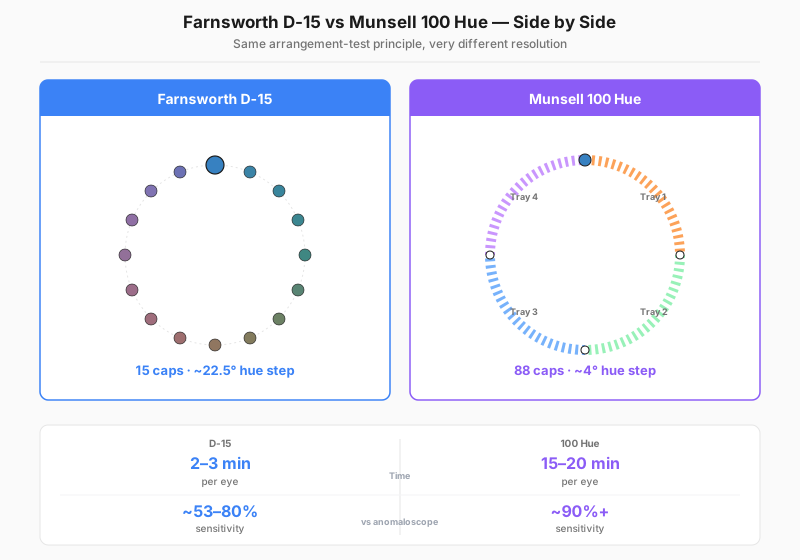
The Farnsworth D-15 (1947) uses 15 movable caps plus a fixed reference cap, spaced evenly around a color circle. The hue steps between adjacent caps are relatively large — about 22.5° on the color wheel. This was deliberate: Farnsworth designed the D-15 as a fast clinical classifier to separate normal or mild color vision from moderate or severe. He didn't try to grade severity precisely. He tried to make a tool a clinic could administer in three minutes.
The Farnsworth-Munsell 100 Hue (1943) is older and bigger. It uses 88 caps split across 4 trays, with hue steps roughly 4° apart — about five times finer than the D-15. Where the D-15 asks "is this person clearly color deficient?", the 100 Hue asks "how well, exactly, does this person discriminate hues across the entire spectrum?" The answer comes as a numeric Total Error Score (TES) that maps continuously from near-perfect (TES < 20) to severe deficiency (TES > 400).
Think of it this way: the D-15 is a smoke detector — yes/no with three damage categories. The 100 Hue is a thermometer — continuous reading you can track over time.
Test design at a glance
| Dimension | Farnsworth D-15 | Munsell 100 Hue |
|---|---|---|
| Cap count | 15 movable + 1 reference | 88 movable (4 × 22) |
| Hue step between caps | ~22.5° (coarse) | ~4° (fine) |
| Time per eye | 2–3 min | 15–20 min |
| Output | Pass/Fail + protan/deutan/tritan axis | Total Error Score (continuous, 0–~1200) |
| Sensitivity (vs anomaloscope) | ~53–80% | ~90%+ |
| Specificity | ~97–100% | ~95% |
| Detects mild defects? | Weak — often misses mild deuteranomaly | Strong — picks up subtle hue discrimination loss |
| Detects acquired vs congenital | Indirectly (via anarchic patterns) | Yes — clear tritan-axis bias is a classic acquired-disease signature |
| Online version reliability | Medium — saturated caps tolerate screen variation | Lower — fine hue steps demand calibrated monitor |
| Typical clinical context | Occupational screening (police, military, FBI), follow-up after Ishihara fail | Glaucoma / diabetic retinopathy / optic neuritis monitoring, vision research |
Sensitivity & specificity — what the research actually says
The most commonly cited head-to-head study is Hovis et al., "Comparison of the Farnsworth-Munsell 100-Hue, the Farnsworth D-15, and the L'Anthony D-15 desaturated color tests" (PubMed 8489445), published in Archives of Ophthalmology in 1993. Subjects with glaucoma were tested with all three.
The key finding: the D-15 and the 100 Hue produced strongly correlated severity scores, meaning the D-15 isn't just a worse version of the 100 Hue — it captures the same underlying severity dimension, just with coarser resolution. The D-15 is faster, missed mild defects more often, and produced more variable type-classification on subjects with subtle deficiencies. The 100 Hue was more sensitive to mild discrimination loss and produced cleaner type identification, at the cost of 5–6× the administration time.
The practical translation: if you fail the D-15, you almost certainly have a real, moderate-or-worse color vision deficiency (high specificity, ~97–100%). If you pass the D-15, you might still have a mild deficiency the test couldn't catch (~50–80% sensitivity).
This is why the standard clinical workflow uses both: the D-15 to rule out moderate-or-severe deficiency quickly, and the 100 Hue (or the Lanthony desaturated D-15) when you need to detect or monitor mild changes.
Which test catches what
D-15 is well-suited to detect
- • Moderate-to-severe congenital red-green deficiency (protanopia, deuteranopia)
- • Strong congenital tritan deficiency (rare but unambiguous on D-15)
- • Pass/fail determination for occupational standards
- • Rapid screening when you already know there's an issue and want to classify it
100 Hue is well-suited to detect
- • Mild congenital deficiencies (deuteranomaly, protanomaly)
- • Acquired tritan-axis defects from glaucoma, diabetic retinopathy, drug toxicity
- • Subtle hue discrimination loss tracked across time
- • Severity grading needed for research, surgical outcome studies, or insurance claims
When clinicians choose which
In a typical optometry or ophthalmology workflow, the test choice is driven by the clinical question being asked.
A patient fails the Ishihara plates. The clinician needs to know: is this red-green or blue-yellow? Mild or severe? The D-15 is the standard next step. It takes 3 minutes, classifies the type, and tells you whether the defect is mild or clinically significant.
A patient is being monitored for glaucoma. Tritan-axis color discrimination is one of the earliest signs of progressive optic nerve damage — often appearing before visual field defects show up. Here the 100 Hue is the right tool because you need the numeric Total Error Score to track over years. The Lanthony desaturated D-15 is sometimes substituted for the same purpose with less time burden.
A pre-employment color vision exam. The agency specifies the D-15 (or the Cone Contrast Test, or the Waggoner CCVT — but rarely the 100 Hue) because they care about pass/fail thresholds, not severity grading. Taking the 100 Hue for an occupational exam is overkill and won't change the outcome.
A surgeon doing macular surgery. Pre- and post-op color vision changes need precise measurement. 100 Hue, every time, because the change you're trying to detect may be 30–50 TES points — invisible on the D-15.
Cost & accessibility
The physical Farnsworth D-15 kit costs roughly $200–$400 and is widely stocked in optometry offices, occupational medicine clinics, and military medical units. The Munsell 100 Hue kit costs roughly $1,200–$1,800 and is mostly found in vision-research labs, large ophthalmology practices, and hospital-based eye clinics.
This cost gap explains a lot of clinical practice. Even when the 100 Hue would be the "more correct" test scientifically, clinicians use the D-15 because it's the test they own and the test that fits a 15-minute appointment.
Online versions of both are free. The D-15 maps reasonably well to digital because its hue steps are large; the 100 Hue is noticeably more screen-dependent because its hue steps are small enough to be affected by display gamut and color calibration.
Are online versions reliable?
Honest answer: approximately, not exactly. No online color vision test can replicate the spectral output of clinical D65 daylight illumination. Screen color gamut, ambient light, brightness setting, Night Light / blue light filters, operating system color profiles, and even the monitor's age all affect what colors your eyes actually see.
That said, two practical findings:
- The online D-15 is fairly robust. The cap colors are highly saturated, so even with display imperfections, a person with normal vision will usually arrange them correctly and a person with moderate-or-worse deficiency will usually make characteristic errors. Studies of online D-15 variants report sensitivity in the 70–80% range against clinical baselines — comparable to the printed test under imperfect lighting.
- The online 100 Hue is less reliable. Its 4° hue steps are inside the variation introduced by consumer displays, so people with normal vision routinely produce TES scores 20–40 points worse than their clinical result. The pattern (axis bias) usually holds up; the absolute number doesn't.
Use either online version for self-screening and curiosity. For anything that affects your career, medical record, or insurance, get the clinical version.
Which one should you take?
Quick decision tree:
- Failed Ishihara, want to know what type? → Take the D-15.
- Suspect a mild deficiency the D-15 might miss? → Take the Lanthony desaturated D-15 first (faster, more sensitive to mild defects), then the 100 Hue if you want a numeric score.
- Preparing for a police, military, or FBI exam? → Take the D-15. That's what they administer. Read our how to pass the D-15 test guide before you go in.
- Pilot exam? FAA? → Neither. As of January 2025, the FAA discontinued recognition of the D-15. Approved alternatives now include the CAD test and the Waggoner CCVT. Confirm current requirements with your AME.
- Being monitored for glaucoma, diabetes, or optic nerve disease? → Take the 100 Hue — that's the test designed for tracking acquired changes over time.
- Just curious? → Take both. They take 25 minutes combined, they're free, and seeing your own pattern on two different resolutions is genuinely interesting.
Sources
- Hovis JK, Cawker CL, Cranton D, Lovasik JV (1993). Comparison of the Farnsworth-Munsell 100-Hue, the Farnsworth D-15, and the L'Anthony D-15 desaturated color tests. Archives of Ophthalmology, 111(5):642–645.
- Vingrys AJ, King-Smith PE (1988). A quantitative scoring technique for panel tests of color vision. Investigative Ophthalmology & Visual Science, 29(1):50–63.
- Farnsworth D (1943). The Farnsworth-Munsell 100-Hue and Dichotomous Tests for Color Vision. Journal of the Optical Society of America, 33(10):568–578.
- Birch J (1997). Diagnosis of Defective Colour Vision, 2nd ed. Butterworth-Heinemann. Standard reference for both tests.
- National Eye Institute — Color blindness overview.
Editorial note. This comparison synthesizes peer-reviewed studies (cited above), standard color vision reference textbooks (Birch, Diagnosis of Defective Colour Vision, 2nd ed.), and clinical practice descriptions from optometry training materials. It is not authored by a licensed clinician and should not replace professional examination. To report a factual error or an outdated citation, write to support@colorblindtests.net.