
Tritanopia (Blue-Blind): Rare, Sex-Neutral, and Often Acquired
Tritanopia is a blue-yellow color blindness caused by missing blue-sensitive S-cones. It behaves very differently from red-green types — it is not sex-linked, and it is more often acquired from diabetes, glaucoma, or aging.
~1 / 30k–50k
Prevalence (inherited)
Equal
Sex ratio (not X-linked)
S
Missing Cone (Blue)
Tritanopia is a blue-yellow color vision deficiency in which the blue-sensitive S-cones are completely absent or nonfunctional. The person sees through only the L and M cones, losing discrimination along the blue-yellow axis. It behaves nothing like the red-green types: far rarer, equal between the sexes, and — most notably — more often acquired than inherited.
Colors commonly confused (blue-yellow)
Light blue ↔ gray, dark violet ↔ black, mid-green ↔ blue, orange ↔ red, yellow ↔ pink. Notably, red-green discrimination stays normal — a standard Ishihara test shows no errors for someone with tritanopia.
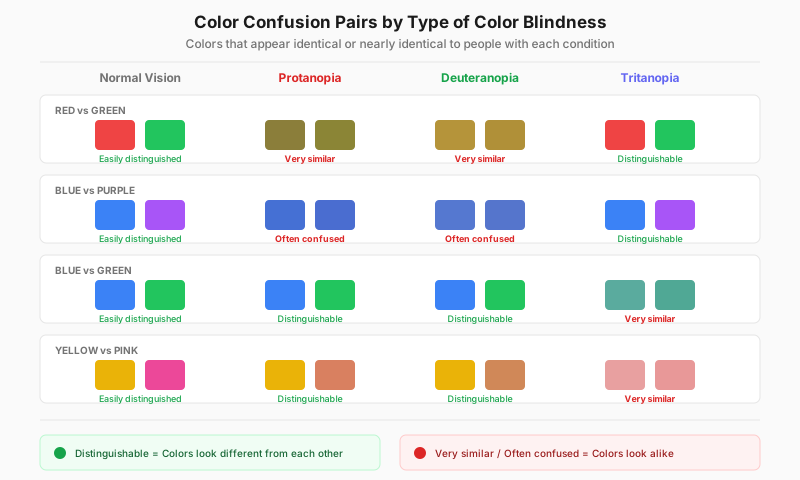
Each type confuses different color pairs: red-green types confuse the top rows, blue-yellow types (tritanopia) confuse the bottom rows.
What Tritanopia Actually Is
Human color vision relies on three cone types. The S-cone peaks in sensitivity around 420 nm (short-wavelength, blue light). When the S-cones are absent or nonfunctional, the brain loses the blue-yellow opponent axis. Blues and greens get confused, yellows can look pink or light gray, the sky can look greenish, and violets often cannot be told apart from dark red-brown. Because S-cones are naturally the least numerous cone in the retina, deficiencies involving them present differently from red-green types.
Acquired vs. Inherited — Tritanopia's Most Distinctive Trait
Red-green color blindness is almost always congenital and stable. Tritanopia is different — it is more often acquired, and that is the most important thing to know about it. Inherited tritanopia, caused by a defect in the OPN1SW gene on chromosome 7, is rare. Acquired blue-yellow deficiency is comparatively common and can result from:
- Diabetic retinopathy — reduced blue-yellow discrimination is often an early sign.
- Glaucoma — affects the optic nerve and can damage the blue-yellow pathway.
- Age-related macular degeneration and other retinal disease.
- Natural aging of the lens — the lens yellows with age, absorbing more blue light and producing a gradual tritan-like shift.
- Exposure to certain industrial solvents and medications.
The clinical takeaway is direct: if an adult newly develops a blue-yellow color problem — especially in one eye, or alongside other visual changes — it is worth an eye exam. It can be a signal of a treatable underlying condition rather than just "being colorblind."
How It Affects Everyday Vision
A tritanope's red-green discrimination is completely normal, so many of the "classic" color-blindness struggles (traffic lights, red-green charts) are not a problem for them. What is affected is the blue-yellow side: telling shades of blue from green, judging whether something is yellow or pink, reading palettes built mainly on blue and yellow. Because these situations are less common day-to-day than red-green ones, people with inherited tritanopia sometimes discover it late.
Causes and Genetics
Inherited tritanopia is caused by a defect in the OPN1SW gene, which sits on chromosome 7 — an autosome, not a sex chromosome. Because inheritance is not tied to sex, it affects men and women equally (a sharp contrast with X-linked red-green color blindness). Inherited tritanopia is passed down in an autosomal dominant pattern with incomplete penetrance, meaning family members carrying the same gene can be affected to very different degrees. For a deeper look at inheritance, see our genetics of color blindness guide.
How Tritanopia Is Diagnosed
The key point: the Ishihara test does not detect tritanopia, because it only screens red-green. Detecting a blue-yellow deficiency needs:
- Blue-yellow color blind test — a screen built for the blue-yellow axis, the first test to take for tritanopia.
- Farnsworth D-15 test — an arrangement test that reveals the tritan confusion axis.
- FM100 Hue test — the most detailed arrangement test; identifies type and severity.
- Anomaloscope and a clinical eye exam — to confirm and to check for an acquired cause.
When to See a Doctor
Because tritanopia is often acquired, this section matters more for it than for other types. If your blue-yellow color vision is newly acquired, affects only one eye, is getting worse, or comes with reduced visual acuity, see an eye-care professional promptly. Acquired blue-yellow deficiency can be an early sign of diabetes, glaucoma, or retinal disease — catching the underlying cause early can sometimes prevent further vision loss.
Daily Life Impact (5 Concrete Scenarios)
- Blue vs. green — blue-green clothing, decor, and icons are hard to distinguish.
- Yellow vs. pink/gray — pale yellow flowers and food colors get misread.
- Blue-yellow palettes — some charts, maps, and UI designs are hard to read.
- Sky and nature — the sky can look greenish and water colors seem off.
- Health monitoring — for acquired tritanopia, watching color changes can be a clue to an underlying condition.
Tips and Adaptation
- Use labels and patterns instead of blue-yellow color coding alone.
- A phone color-picker app can name an object's true color on the spot.
- OS-level colorblind filters and high-contrast modes improve on-screen reading.
- If acquired, manage the underlying cause with your doctor (blood sugar, eye pressure).
- Choose colorblind-safe palettes (Wong, Viridis) and avoid hard-to-tell blue-yellow combinations.
Frequently Asked Questions
Sources
- National Eye Institute (NEI) — Overview of color blindness types including blue-yellow
- American Academy of Ophthalmology (AAO) — Clinical information on blue-yellow color vision deficiency
- National Health Service (NHS) — Causes and management of acquired colour vision deficiency
- Colour Blind Awareness — Acquired colour vision defects including blue-yellow
Take the Blue-Yellow Test
Screen for blue-yellow deficiency (Ishihara can't)
View Simulation
See the world through tritanopia
Related Types
- Protanopia (Red-Blind) — red-green blindness with missing L-cones; reds are additionally darkened
- Deuteranopia (Green-Blind) — red-green blindness with missing M-cones; reds keep normal brightness
- All 8 types of color blindness — overview